
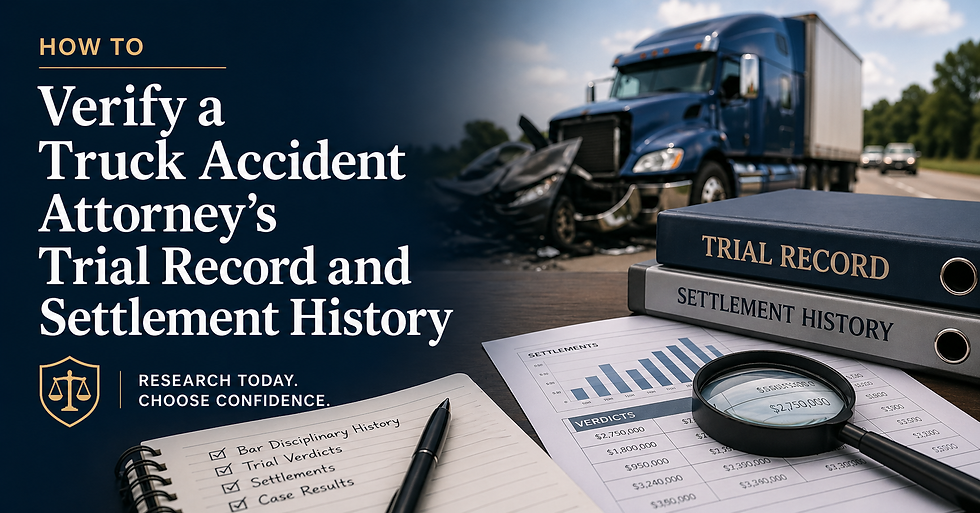
How to Verify a Truck Accident Attorney's Trial Record and Settlement History
- Apr 27
- 21 min read
Updated: Apr 28
Last Reviewed: April 27, 2026
Publisher: PI Law News
Author: Peter Geisheker
This article is for informational purposes only and does not constitute legal advice. Reading it does not create an attorney-client relationship. Consult a licensed attorney in your jurisdiction for guidance on your specific situation.
Verifying a truck accident attorney's trial record and settlement history requires four independent checks: confirm an active license and clean discipline record on the state bar's online lookup, pull federal case dockets through PACER and state court records online, search verdict reporter databases such as VerdictSearch, Westlaw Verdicts, or Lexis Jury Verdict Analyzer, and confirm board certifications through the National Board of Trial Advocacy directory.
Key Facts at a Glance
In 2023, 5,375 large trucks were involved in fatal crashes in the US, an 8.4% decrease from 2022 (Federal Motor Carrier Safety Administration).
Approximately 95–96% of personal injury cases settle before trial, meaning fewer than 1 in 20 cases generate a public verdict (Clio Personal Injury Law Statistics, 2026).
The National Board of Trial Advocacy has certified roughly 2,400 attorneys nationwide across all specialty areas, including a separate Truck Accident Law board certification administered with the Academy of Truck Accident Attorneys.
The American Bar Association approved Truck Accident Law as the first ABA-accredited board certification specialty for truck accident attorneys on August 7, 2018 (ATAA).
PACER provides electronic public access to over 1 billion federal court documents at $0.10 per page with a $3.00 cap per document, and waives fees for any quarter where charges total $30 or less (Administrative Office of the U.S. Courts).
Approximately 10% of all attorneys hold a Martindale-Hubbell AV Preeminent rating, the highest peer review designation available (Martindale-Hubbell).
49 CFR Parts 390–397 establish the Federal Motor Carrier Safety Regulations, whose violations frequently form the basis of trucking liability claims (Electronic Code of Federal Regulations).

A commercial truck accident case is unlike any other personal injury matter. The defendants are commercial motor carriers backed by aggressive defense firms, the insurance policies routinely run into the millions, and the federal regulatory framework — the Federal Motor Carrier Safety Regulations under 49 CFR Parts 390–397 — adds a technical layer that general personal injury attorneys are often unprepared to handle. The choice of counsel directly determines case value, and that choice is made under pressure, usually within days or weeks of a catastrophic crash.
Yet the lawyer-selection process is dominated by marketing claims that are nearly impossible to evaluate at face value. Television commercials, sponsored search ads, and "Super Lawyers" magazine covers are paid placements or peer-popularity awards — not verification of trial competence. Self-reported "$50 million recovered" figures are unaudited. "Aggressive trial lawyers" rarely identify a single jury verdict by docket number. The marketing layer obscures the underlying record, and that record is what determines whether a trucking insurer takes the file seriously.
The good news is that the verification information exists in public records. State bar licensure databases, federal court dockets through PACER, state court electronic filing systems, peer-reviewed jury verdict reporters, and ABA-accredited specialty certifications are all searchable — most of them for free, and the rest at modest cost. With a methodical approach, a prospective client can independently verify or refute every meaningful claim a truck accident attorney makes during a consultation, in roughly 60 to 90 minutes of research.
This guide walks through that methodology end-to-end. It covers what the trucking insurance industry already knows about every plaintiff lawyer who walks into a courtroom, how to access those same data sources yourself, which credentials are objectively meaningful versus marketing puffery, what direct questions to ask in the consultation, and the red flags that signal a lawyer is not what their advertising suggests. The goal is not to replace professional legal advice but to give a victim or family member the tools to choose representation based on documented record rather than the size of a billboard.
In this article:
Why verification is uniquely critical in commercial truck cases
How to confirm a truck accident attorney's license and discipline record
How to search federal court dockets through PACER
How to search state court records online
Which verdict and settlement databases are worth using
What board certifications mean — and how to verify them
How to read peer review ratings and avoid pay-to-play awards
The questions to ask in a consultation and how to verify the answers
Red flags that signal trial record exaggeration
Comparison of verification methods at a glance
Frequently asked questions
References
Why Is Verifying a Truck Accident Attorney So Different From Hiring Other Lawyers?
Verifying a truck accident attorney is different because the case stakes, the defense resources, and the regulatory framework all amplify the consequences of choosing wrong. A general personal injury attorney who handles a truck case the same way they handle a fender-bender will leave money on the table — often a large amount.
Commercial trucking insurance policies frequently carry $1 million in mandatory federal minimums under 49 CFR § 387.9 for general freight, and far higher for hazmat carriers. Trucking defense firms specialize in handling exactly these cases — they preserve their own evidence within hours of a crash, and they know which plaintiff attorneys have actually tried trucking cases versus which simply settle every file. The industry tracks plaintiff attorneys' records far more carefully than most clients realize. An insurer's reserve setting and settlement posture often turn on the specific lawyer who has filed the case, not on the case facts alone.
That asymmetry is what makes verification so important. The trucking defense bar already knows which attorneys are credible trial threats. A prospective client without access to that institutional memory is at a steep informational disadvantage — but the underlying public records that build that memory are accessible to anyone willing to look.
How Do You Verify a Truck Accident Attorney's License and Discipline Record?
You verify license status and discipline through the state bar's online attorney lookup tool, which is free and authoritative. Every US jurisdiction maintains a public-facing search tool that returns current license status, admission date, and any public disciplinary history.
Start with the bar where the attorney is admitted. Search by name or bar number. The profile will show one of several status labels — "Active," "Inactive," "Not Eligible to Practice," "Suspended," or "Disbarred." Only "Active" attorneys can represent you. Reading carefully matters: an attorney listed as "Not Eligible" may have simply missed an administrative deadline like CLE compliance, while a "Suspended" attorney has gone through a formal disciplinary proceeding (LegalClarity, 2026).
Most state bar profiles include a discipline history section. The Florida Bar's profile, for instance, displays a 10-Year Discipline History block roughly three-fourths down the attorney's profile page, with clickable links to the actual Florida Supreme Court orders or Reports of Referee for each sanction (The Florida Bar). California's State Bar Court maintains online dockets for most public discipline cases filed since 2000, accessible by attorney name or case number with no login required (State Bar of California). North Carolina's database covers public discipline imposed by the Grievance Committee from 1999 to the present (North Carolina State Bar).
Read the actual disciplinary order if one exists. The one-line status label rarely tells you whether the underlying conduct was a fee dispute or theft of client funds — and the difference matters.
How Do You Verify a Truck Accident Attorney's Trial Record Using Public Databases?
You verify a trial record by searching public court dockets — PACER for federal cases and state court electronic filing systems for state cases — and cross-referencing the results against verdict reporter databases. A trial record consists of cases that went to verdict, not just cases that were filed.
This is the most-skipped step in attorney vetting. The reason is that "track record" claims on attorney websites are typically self-reported settlement totals — figures that may include cases the attorney inherited, cases their firm settled before they joined, or pre-litigation insurance settlements that did not require courtroom skill at all. None of those are trial verdicts. A trial verdict is a finding entered by a judge or jury after a contested trial, and it carries the docket number, judge, and verdict amount on permanent public record.
The verification workflow has three pieces: (1) ask the attorney directly for the docket numbers and venues of their trial verdicts, (2) pull those dockets from the relevant court system to confirm the verdict and the attorney of record, and (3) cross-check the dollar figures against an independent verdict reporter where available. Each of those steps is covered in detail below.
How Does PACER Work and What Does It Actually Show?
PACER is the federal courts' Public Access to Court Electronic Records system, and it provides searchable access to virtually every federal civil, criminal, bankruptcy, and appellate court record. Anyone can register; access costs $0.10 per page with a $3.00 cap per document, and fees are waived for any quarter where total charges fall below $30.
PACER provides instantaneous access to more than 1 billion documents filed at all federal courts, and 75% of users pay no fee in any given quarter because they fall under the $30 quarterly waiver threshold (Administrative Office of the U.S. Courts). To search across all federal courts, use the PACER Case Locator — a national index that returns party name, court, case number, filing date, and closing date for any case where the attorney appears (PCL).
What PACER will not do is tell you whether a case went to trial — you have to read the docket. Look for entries like "Jury Trial Held," "Verdict Entered," "Bench Trial," or "Judgment as a Matter of Law." A docket showing only a complaint, an answer, scheduling orders, and a "Stipulated Dismissal" is a settled case, not a tried one. Both have value — but conflating them is exactly what overstated attorney marketing relies on.
The free alternative is CourtListener's RECAP Archive, which contains millions of crowdsourced PACER documents collected through a browser extension. Coverage is incomplete, but it costs nothing and is searchable without registration.
How Do You Search State Court Records for an Attorney's Cases?
State court access varies dramatically by state, but every state has at least some form of public docket lookup, and the major commercial trucking venues — Texas, California, Florida, Georgia, Illinois, Pennsylvania — have robust online systems. Search the state court website where the attorney practices using the attorney's name, then review individual case dockets for verdict entries.
Most state court systems are structured around county- or district-level case management portals. Texas's re:SearchTX provides statewide attorney searching across most counties, while California's individual Superior Court systems (Los Angeles, San Francisco, Orange County) each maintain separate online dockets. Georgia uses Peach Court for many counties. Where statewide systems do not exist, you may need to search county-by-county for the venues where the attorney has actually filed cases — usually the metro counties closest to the attorney's office.
A useful shortcut is to ask the attorney directly which counties they have tried cases in. Cross-reference that list with state and federal docket searches. If the attorney claims trial experience in a venue and no docket appears, ask why. There may be a legitimate explanation — joint representation, motion-only appearances, cases filed under the firm's name — but the discrepancy is worth raising before signing a fee agreement.
Which Verdict and Settlement Databases Give a Complete Picture?
The most thorough verdict and settlement coverage comes from the major commercial verdict reporters: VerdictSearch (ALM/Law.com), Westlaw Jury Verdicts & Settlements, Lexis Jury Verdict Analyzer, and state-specific reporters like the Illinois Jury Verdict Reporter and California's Jury Verdict Alert. These are paid databases with deep coverage — and they are the same sources defense firms and insurance carriers use.
VerdictSearch publishes more than 200,000 verdicts and settlements and is the only verdict reporter that solicits feedback from both winning and opposing attorneys to verify case data (Law.com). LexisNexis's Verdict & Settlement Analyzer covers more than 1.1 million verdicts and settlements, with searchable filters by jurisdiction, attorney, expert witness, injury type, and award range (Drake University Law Library). The Illinois Jury Verdict Reporter maintains over 55,000 Illinois case summaries spanning more than 60 years and explicitly markets "Checking an attorney's trial record" as one of its primary use cases (Law Bulletin Media).
These databases are subscription-based and not free. However, many county and university law libraries provide free public access on-site, and some state bar associations offer member-only access that an attorney friend or family member with a bar membership can search on your behalf. For free alternatives, JuryVerdictAlert.com offers California verdict summaries and full-text search by attorney name with day-pass and week-pass options at modest cost. The National Association of State Jury Verdict Publishers maintains links to state-specific verdict reporters for most US jurisdictions.
A pattern in verdict reporters is that the data depends on attorney self-submission — attorneys submit their wins for publicity. That is useful when present (the case file has been confirmed), but not exhaustive. An absence in a verdict reporter does not necessarily mean an attorney has no verdicts; it means they have not submitted any, which itself is a question worth asking.
What Does Board Certification Actually Verify?
Board certification verifies that an attorney has met objective experience, exam, and peer-review standards set by an ABA-accredited certifying organization. For truck accident attorneys, the relevant credential is the Truck Accident Law board certification administered by the National Board of Trial Advocacy in partnership with the Academy of Truck Accident Attorneys.
This certification is unique — and recent. The American Bar Association approved Truck Accident Law as a board certification specialty area on August 7, 2018, making it the first and only ABA-accredited board certification specifically for truck accident attorneys (ATAA). To earn it, an attorney must demonstrate that a substantial percentage of their practice is devoted to trucking litigation, document hands-on experience in multiple truck accident cases, secure peer and judicial references attesting to their trial competence, and pass a comprehensive written examination administered by the NBTA.
The NBTA also offers a separate board certification in Civil Trial Law, which requires trying a minimum number of civil jury cases to verdict, peer references, exam passage, and ongoing CLE compliance. NBTA has certified close to 2,400 attorneys nationwide across all of its specialty areas — a small fraction of the more than 1.3 million licensed US attorneys (Wikipedia, citing NBTA records). Verify any claimed certification directly through the NBTA member directory or the ATAA Board Certified Attorneys directory, both of which are searchable by name and state.
State-level certifications also exist — Texas Board of Legal Specialization in Personal Injury Trial Law, Florida Bar Board Certification in Civil Trial Law, North Carolina State Bar Board Certified Specialist programs — and are equally valid in their respective states. Membership in attorney organizations like the American Association for Justice or the Million Dollar Advocates Forum is not board certification; those are dues-paying memberships, not credentialing programs.
How Do You Read Peer Review Ratings Without Being Misled?
The most credible peer review system is Martindale-Hubbell, which has published attorney ratings since 1887 and bases its current ratings on confidential surveys of fellow attorneys and judges. The highest tier — AV Preeminent — is held by approximately 10% of all attorneys nationwide and signifies a 4.5–5.0 score on a 5-point scale across legal knowledge, analytical capability, judgment, communication, and experience (Martindale-Hubbell).
A Martindale-Hubbell AV Preeminent rating is meaningful because the survey methodology requires a threshold number of qualifying responses from peer attorneys and judges, and because the system has been continuously published for more than 130 years — making the data harder to game than newer rating services (Martindale-Hubbell). The ratings reflect both ethics ("Very High General Ethical Standards") and legal ability separately, so an attorney must clear both bars to receive the top designation.
Other ratings systems should be evaluated on methodology, not on the prominence of their advertising. Super Lawyers is a peer-nominated annual list operated by Thomson Reuters; "Top 100" or "Top 50" lists within it are rankings within Super Lawyers. Avvo's 1–10 numerical rating is algorithm-driven and weights factors like license status, peer endorsements, and disciplinary history; it can be useful as a starting point but is not a peer-reviewed credential. Best Lawyers, Lawdragon 500, and similar lists each have their own selection methodologies. Always check the methodology before treating any rating as authoritative — and treat any "award" the attorney paid to apply for as marketing rather than independent recognition.
What Direct Questions Should You Ask in the Consultation?
Ask specific, verifiable questions — and write down the answers so you can independently check them after the meeting. A truck accident attorney who is honest about their record will welcome verification. Vague answers, deflection, or pressure to sign immediately are the warning signs.
The high-yield questions cluster into five areas: trucking-specific experience, trial record, who handles the file, fees and costs, and evidence preservation. The most useful single question is the one Avvo's legal community recommends: "Provide a list of actual jury verdicts you have obtained, with docket numbers, so I can independently confirm" (Avvo legal answers thread). An attorney with real trial experience will provide that list without hesitation. An attorney who deflects ("we settle most of our cases at top dollar," "verdicts don't tell the whole story") may be signaling that the trial record they advertise does not exist in the form advertised.
Other essential questions include: How many truck accident cases have you personally tried to verdict in the last five years? What percentage of your practice is dedicated to commercial truck litigation? Are you board-certified in Truck Accident Law or Civil Trial Law, and by which organization? How quickly does your firm send preservation letters and obtain ELD/black box data after a crash? Will you personally handle my case, or will it be passed to an associate or paralegal? What is your fee structure, including expenses, and at what point in the case do those expenses come out of any recovery? If we don't settle, are you prepared to take this case to trial, and how many cases has your firm tried in the last 24 months?
Each of those answers is independently verifiable using the methods covered earlier in this article.
Speak with a personal injury attorney for guidance on your specific situation.
What Are the Red Flags That Signal Exaggerated Trial Records?
Red flags are the patterns that emerge when claimed credentials don't survive verification. Specific, repeating signals separate genuine trial lawyers from marketing-driven generalists.
The most reliable red flag is refusal to provide docket numbers. Any honest trial lawyer who claims trial verdicts can name them with court, case number, and year — and will know their own results well enough to summarize the facts and damages on demand. Vague references to "a $5 million verdict in Cook County a few years ago" without specifics is not a trial record; it is marketing language.
A second pattern is conflation of "results" with "verdicts." Attorney websites often list large dollar figures under headings like "Notable Results" or "Recent Recoveries" without distinguishing between trial verdicts, structured settlements, pre-litigation insurance payouts, and policy-limit tenders. Ask which of the listed results were actual jury or bench verdicts. A third pattern is generalist practice masquerading as specialization — a firm that handles "personal injury, family law, criminal defense, immigration, and truck accidents" is not a truck accident specialist, regardless of how the website is organized.
Other persistent red flags include: pressure to sign a representation agreement at the first meeting; guarantees of specific dollar outcomes; inability to articulate what makes a truck accident case different from a car accident case; no NBTA, ATAA, or state-level board certification, and no clear explanation for the absence; claimed truck case experience but no docket entries appearing in any state or federal court database; AV Preeminent claims that don't appear on the attorney's martindale.com profile; and any unwillingness to put fee terms and trial-readiness commitments in writing.
Get a free case evaluation to discuss your situation with someone who can help.
How Do the Major Verification Methods Compare?
▶ TABLE: Verification methods compared by cost, depth of information, time required, and reliability — replace with Wix table widget during Step 9A manual review.
The summary below covers the major verification methods discussed in this article. No single source provides complete information; the methods are complementary, and serious vetting uses several in combination.
Verification Methods Comparison
State Bar Lookup — Cost: Free | Shows: License status, admission date, public discipline | Time: 5 min | Reliability: Authoritative for license/discipline | Best Use: First step before any other check.
PACER (Federal) — Cost: $0.10/page, $3 cap, $30/qtr waiver | Shows: Federal case dockets, parties, attorneys, verdicts | Time: 15–30 min | Reliability: Authoritative | Best Use: Verifying federal trial activity.
State Court Online Dockets — Cost: Free or low-cost | Shows: State case dockets and verdicts | Time: 30–60 min | Reliability: Authoritative but coverage varies by state | Best Use: Verifying state-court trial activity.
VerdictSearch / Lexis / Westlaw — Cost: Subscription (often free at law libraries) | Shows: Detailed verdict summaries with attorneys, experts, awards | Time: 15–30 min | Reliability: Self-reported but verified by publishers | Best Use: Cross-checking verdict claims.
CourtListener / RECAP — Cost: Free | Shows: Crowdsourced PACER documents | Time: 10–20 min | Reliability: Coverage incomplete | Best Use: Free alternative for federal docket research.
NBTA / ATAA Directory — Cost: Free | Shows: Board certification status | Time: 2 min | Reliability: Authoritative | Best Use: Verifying claimed board certification.
Martindale-Hubbell — Cost: Free to view | Shows: Peer review rating, ethics, legal ability | Time: 5 min | Reliability: Methodologically rigorous | Best Use: Peer reputation context.
Avvo / FindLaw / Super Lawyers — Cost: Free | Shows: Algorithm/peer-nomination ratings | Time: 5 min | Reliability: Useful as a starting point only | Best Use: Initial screening.
Direct Consultation — Cost: Free | Shows: Attorney's own claims | Time: 30–60 min | Reliability: Requires independent verification | Best Use: Generating the list of claims to verify.
A complete verification typically takes 60 to 90 minutes if executed methodically: 5 minutes on the state bar, 30 minutes on PACER and state dockets, 15 minutes on a verdict reporter (or its free alternatives), 5 minutes on board certification directories, and the rest on Martindale-Hubbell and consultation answers cross-checked against the docket evidence.
How Should You Document and Compare Multiple Attorneys?
Document each attorney's verified record on a single comparison sheet so you can compare evidence, not impressions. Marketing materials are designed to be persuasive in isolation; side-by-side comparison neutralizes that effect.
A simple comparison sheet should include: full attorney name and bar number; state bar status and any discipline; years admitted; truck-specific cases verified through public dockets in the past five years; jury or bench verdicts located through verdict reporters; board certifications (with verifying directory URL); Martindale-Hubbell rating; fee percentage and expense terms; primary attorney who will personally handle the file; and a column for the lawyer's responsiveness and clarity during the consultation.
Discuss your case at no cost if you would like guidance on what to verify and what red flags matter most for your specific situation.
The information you collect is the same information the trucking insurer will use to set their reserve once a complaint is filed. Choosing an attorney whose verified record matches their marketing aligns the leverage on your side from day one.
Frequently Asked Questions
Are truck accident settlements public record?
Most truck accident settlements are not public record because they are resolved through private agreements between the parties before any verdict is entered. According to data summarized by personal injury legal sources, approximately 95% of personal injury cases settle before trial, and those settlements typically include confidentiality provisions that prevent disclosure of the settlement amount or terms (Clio).
The exceptions are settlements that go through court approval — most commonly cases involving minors, wrongful death claims requiring probate court approval, or cases involving government entities that may be subject to public disclosure laws. In those situations, settlement amounts can appear in court records. Cases that do go to verdict become permanent public record, with verdict amounts, parties, attorneys, and judgments accessible through PACER for federal cases and state court systems for state cases.
How do I check if a lawyer has been disciplined?
Check disciplinary records through the state bar's online attorney lookup tool in the state where the attorney is licensed. Every US state and territory maintains a free public database listing attorney status, admission date, and any public disciplinary history.
FindLaw publishes a state-by-state chart of every state bar's disciplinary lookup tool, with direct links (FindLaw). California's Attorney Search at calbar.ca.gov flags any public disciplinary history on the attorney's profile and links to the State Bar Court's actual decision documents (LegalClarity). Florida, Texas, New York, Illinois, and other major commercial-trucking jurisdictions all have similar lookup tools. Note that private reprimands and dismissed complaints are generally not made public, so the absence of disciplinary entries does not guarantee no complaints have ever been filed — only that no public sanctions were imposed.
How do I verify an attorney is licensed in my state?
Verify licensure by searching the state bar's online attorney directory using the attorney's name or bar number. Status of "Active" or "Active Member in Good Standing" confirms current licensure. Any other status — "Inactive," "Suspended," "Disbarred," or "Not Eligible" — means the attorney is not currently authorized to represent you in that state.
If the attorney is licensed in multiple states, verify each state separately — an attorney can be in good standing in one state and suspended in another. For attorneys representing you in a state where they are not admitted (which is permitted only with local counsel and pro hac vice admission), the case docket should reflect both attorneys of record.
What questions should I ask a truck accident lawyer about their trial experience?
Ask specific, docket-verifiable questions: How many truck accident cases have you personally tried to verdict in the past five years? Can you provide the case names and docket numbers so I can verify them independently? What percentage of your active caseload is commercial trucking litigation? Are you board-certified in Truck Accident Law or Civil Trial Law, and by which organization?
The Avvo legal community specifically recommends requesting a list of actual jury verdicts with docket numbers so they can be independently confirmed (Avvo). An attorney with real trial experience will respond directly. Deflection ("we don't focus on trials, we focus on results"), generalities ("we've recovered millions"), or refusal to name specific cases are signals that the trial record described in marketing materials may not survive scrutiny.
How do I look up a lawyer's federal court cases?
Look up federal cases through the Public Access to Court Electronic Records (PACER) system. Register for a free PACER account, then use the PACER Case Locator to run a nationwide search by attorney name. The locator returns the court, case number, parties, filing date, and closing date for each case where the attorney appears.
Charges are $0.10 per page with a $3.00 cap per document, and fees are waived if you accrue less than $30 in any calendar quarter. The free RECAP Archive at CourtListener.com provides a searchable subset of PACER documents at no cost for casual users who do not need comprehensive coverage.
What does it mean for a lawyer to be board-certified in truck accident law?
Board certification in truck accident law means an attorney has met objective experience, examination, and peer-review standards set by the National Board of Trial Advocacy and the Academy of Truck Accident Attorneys, the only ABA-accredited certifying body for this specialty.
The certification was approved by the ABA on August 7, 2018, making it the first and only ABA-accredited specialty board certification for truck accident attorneys (ATAA). To qualify, an attorney must dedicate a substantial portion of their practice to trucking cases, document hands-on experience in multiple truck accident matters, submit peer and judicial references, and pass a comprehensive written exam administered by the NBTA. The next exam is scheduled and available through the NBTA website. Certification lasts five years, after which the attorney must apply for recertification. Verify any claimed certification through the ATAA Board Certified Attorneys directory.
How can I find out a personal injury attorney's track record of success?
Combine independent public-records research with direct questioning. Check the state bar for license and discipline. Search PACER and state court dockets for cases where the attorney appears. Search verdict reporter databases (VerdictSearch, Lexis, Westlaw, or state-specific reporters like the Illinois Jury Verdict Reporter) for verdicts the attorney has obtained. Verify any board certifications through NBTA or state specialty board directories. Then ask the attorney directly for case names and docket numbers, and confirm they match what the public record shows.
A track record of success in trucking cases consists of verdicts obtained against commercial motor carriers, not aggregate "settlements recovered" figures self-reported on the firm's website. The two are not equivalent. The methodology in this article allows you to verify the difference.
Is a high Avvo rating a reliable indicator of trial competence?
A high Avvo rating is a useful starting point, but is not a reliable standalone indicator of trial competence. Avvo's 1–10 score is algorithmic and incorporates factors like license status, peer endorsements, and disciplinary record — but it does not directly measure trial verdicts or trucking-case experience.
Treat Avvo ratings the way you would a Yelp rating for a restaurant: useful for screening out clearly poor choices and for confirming basic legitimacy, but no substitute for the deeper verification covered in this article. A 10.0 Avvo rating combined with no NBTA certification, no docket-verified trial verdicts, and no state bar specialty designation is a less impressive credential than it appears.
How long does it actually take to verify a truck accident attorney's record?
A thorough verification of a single attorney typically takes 60 to 90 minutes once you know which sources to use. The state bar lookup takes about 5 minutes; PACER and state docket searches another 30–45 minutes; a verdict reporter check 10–15 minutes; board certification verification 2–5 minutes; and Martindale-Hubbell another 5 minutes. The remaining time goes to documentation and cross-referencing.
For three short-listed attorneys, plan on 3–4 hours of verification work total. That is a small investment relative to the multi-year, multi-million-dollar consequences of choosing trucking-case representation. Contact us for a free consultation if you would like guidance on what to verify and what red flags matter most for your specific situation.
What if the attorney refuses to provide docket numbers or specific case references?
Refusal to provide docket numbers for claimed verdicts is one of the strongest red flags in attorney evaluation. The information is public record — the attorney already knows it, and providing it to a prospective client costs them nothing. An attorney who declines, deflects, or insists that "every case is different and past results don't matter" is signaling that the marketing claims may not survive verification.
In that situation, the appropriate response is to thank the attorney for their time and continue evaluating other candidates. Trucking cases involve too much money and too long a timeline to retain an attorney whose advertised track record cannot be verified.
Authoritative References
Federal Motor Carrier Safety Administration — Large Truck and Bus Crash Facts
Insurance Institute for Highway Safety — Large Trucks Fatality Facts
Electronic Code of Federal Regulations — Title 49, Subtitle B, Chapter III (FMCSA)
Academy of Truck Accident Attorneys — Board Certified Attorneys Directory
Academy of Truck Accident Attorneys — Certification Information
State Bar Court of California — Public Records & Information
The Florida Bar — How to Find Attorney Discipline Public Records
FindLaw — Researching Attorney Discipline (state-by-state chart)
Wikipedia — National Board of Trial Advocacy (NBTA history and standards)
Drake University Law Library — Jury Awards & Settlements Research Guide
Editorial Standards & Review
This article was researched, written, and fact-checked according to PI Law News's editorial standards. Every statistic was verified against a primary source, and every cited regulation, certification, or database was confirmed live during the writing process. URLs were tested at the time of publication. Where sources could not be verified, claims were omitted rather than included with hedging language.
PI Law News is consumer-facing legal information journalism and is not a law firm. Articles do not constitute legal advice and do not establish an attorney-client relationship. Readers seeking representation should consult a licensed attorney in their jurisdiction.
Last reviewed: April 25, 2026.

