
Who Is Liable in a Multi-Vehicle Jackknife Truck Accident?
Last Reviewed: April 23, 2026
Publisher: PI Law News
Author: Peter Geisheker
This article is for general informational purposes only and does not constitute legal advice. Laws vary by state, and individual circumstances differ. If you were injured in a jackknife truck accident, consult a licensed personal injury attorney in your state to understand your specific rights and legal options.
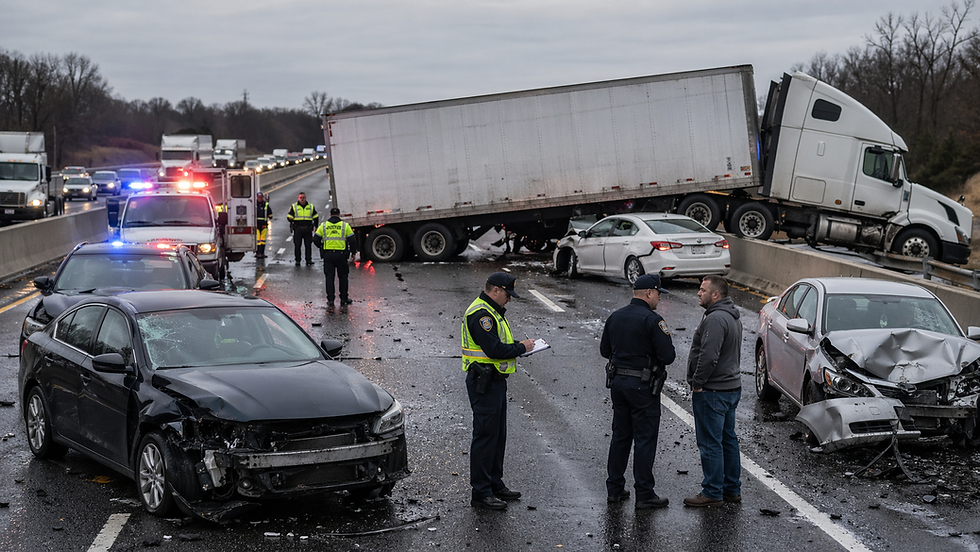
It happens in seconds. A fully loaded tractor-trailer hits its brakes on a rain-slicked interstate. The trailer swings wide, blocking two — sometimes three — lanes of traffic. Cars brake, swerve, and collide. By the time the chaos stops, a dozen vehicles may be involved, first responders are on the way, and families are left wondering: who is liable in a multi-vehicle jackknife accident like this?
The answer is rarely simple. Who is liable in a multi-vehicle jackknife accident depends on a layered investigation into the cause of the crash, the conduct of every party in the chain of events, and the applicable laws of the state where the wreck occurred. Unlike a two-car fender-bender, a jackknife truck accident pileup can involve the truck driver, the trucking company that employed them, the company that loaded the cargo, a third-party maintenance shop, the manufacturer of a defective brake component, and even other motorists who made errors in the chaos.
According to NHTSA data analyzed by legal researchers, the agency recorded 3,029 tractor-trailers involved in jackknife truck accidents in 2023, with jackknifing occurring in 4.4% of fatal crashes involving single-trailer semis and 7.1% of fatal crashes involving multi-trailer semis. Because of the size and momentum of commercial trucks — which can legally weigh up to 80,000 pounds fully loaded — the consequences of a jackknife pileup are almost always catastrophic for everyone in smaller vehicles nearby.
Pursuing fair compensation after a multi-vehicle jackknife accident requires identifying every party who contributed to the crash, gathering physical and electronic evidence before it disappears, and building a legal claim that holds each negligent actor accountable. This guide explains every potential source of liability, how fault is allocated when multiple defendants share responsibility, and what you need to do right now to protect your rights.

KEY TAKEAWAYS Jackknife accidents can — and frequently do — involve multiple liable parties simultaneously, including the driver, their employer, cargo loaders, and maintenance providers. NHTSA recorded 3,029 tractor-trailers in jackknife accidents in 2023; jackknifing appeared in 7.1% of fatal crashes involving multi-trailer semis. (Source) Under the legal doctrine of respondeat superior, a trucking company is generally liable for the negligent acts of its employed drivers acting within the scope of their job. According to the FMCSA’s Large Truck and Bus Crash Facts 2021 report, jackknifing was a factor in 142 fatal large truck crashes — approximately 2.4% of all fatal large truck crashes that year. Secondary accidents — cars colliding while swerving to avoid the jackknifed truck — can create additional layers of liability involving other motorists. Electronic logging device (ELD) data, dashcam footage, and maintenance records are critical evidence that can disappear quickly; act fast. Most states allow two years from the date of the crash to file a personal injury lawsuit, though this varies — consult a commercial truck accident attorney immediately. Occupants of passenger vehicles accounted for approximately 73% of all fatalities in crashes involving large trucks, according to FMCSA data. A truck accident lawyer will investigate all potential defendants to ensure victims pursue maximum compensation from every responsible source.
Table of Contents
What Is a Jackknife Accident and When Does It Become Multi-Vehicle?
Common Causes of Multi-Vehicle Jackknife Accidents
Who Is Liable in a Multi-Vehicle Jackknife Accident? Seven Possible Defendants
How Comparative Fault Works When Multiple Parties Share Liability
Key Evidence Used to Prove Fault in a Multi-Vehicle Jackknife Case
What Damages Can You Recover After a Multi-Vehicle Jackknife Crash?
Legal Deadlines: Statutes of Limitations You Cannot Afford to Ignore
Frequently Asked Questions
Authoritative References
What Is a Jackknife Accident and When Does It Become Multi-Vehicle?
A jackknife truck accident occurs when a tractor-trailer folds at the fifth-wheel coupling — the pivot point connecting cab to trailer — causing the trailer to swing outward at a sharp angle relative to the cab. The name comes from the resemblance to a folding pocket knife snapping open mid-motion. Once the trailer begins that swing, the driver has almost no ability to correct it.
There are two mechanical types of jackknifes. In a trailer jackknife, the trailer’s brakes lock while the cab continues forward, causing the trailer to skid sideways. This is often caused by sudden braking, excessive speed, or improperly adjusted trailer brakes. In a tractor jackknife, the cab’s drive wheels lock — typically when a driver overcorrects a skid — while the trailer’s momentum keeps pushing it forward, folding the rig toward itself. Both types result in a truck occupying multiple traffic lanes simultaneously.
The multi-vehicle dimension emerges because a jackknifed trailer becomes, in effect, a moving wall across the roadway. Vehicles following in adjacent or trailing lanes have only one to three seconds of reaction time before impact — often not enough to stop or evade. Secondary crashes happen as drivers swerve to avoid the jackknifed rig and collide with guardrails, barriers, or other vehicles. In poor visibility conditions — fog, rain, night driving — following drivers may not even see the sideways trailer until they are in it.
A pileup of three, six, or even a dozen vehicles is not uncommon in high-speed jackknife scenarios on highways. Each additional vehicle involved adds complexity: more injured parties, more insurance policies, and more potential defendants whose negligence contributed to the overall collision event.
Common Causes of Multi-Vehicle Jackknife Accidents
Understanding what caused the jackknife is the foundation of any liability analysis. Attorneys and accident reconstruction experts investigate the cause first — because the cause determines who is responsible. The most common causes include:
Improper or Panic Braking. Hard, sudden braking is the leading mechanical trigger of jackknifing. When a driver slams the brakes — whether due to sudden traffic, a merging vehicle, or distraction — the trailer’s momentum continues even as the cab decelerates. If the trailer’s brake system is poorly adjusted or lacks functioning anti-lock brake systems (ABS), locking occurs and the trailer pivots sideways.
Excessive Speed. According to FMCSA records, truckers committed more than 63,500 speeding violations in 2022 alone. A truck traveling too fast for road or weather conditions has insufficient stopping distance and a higher center of gravity — both factors that dramatically increase jackknife risk when sudden braking becomes necessary.
Driver Fatigue. The FMCSA’s Large Truck Crash Causation Study found driver fatigue to be a critical reason in approximately 13% of large trucks involved in fatal and injury crashes, with an associated relative risk factor of 8.0. Fatigued drivers have impaired reaction times and judgment, increasing the likelihood of both the error that requires emergency braking and the overcorrection that triggers the jackknife.
Improper Cargo Loading. When cargo is unevenly loaded, overloaded, or inadequately secured, it shifts during transport. A sudden weight shift while braking — particularly on curves — can alter the truck’s center of gravity and initiate the trailer’s swing. The FMCSA’s Large Truck Crash Causation Study identified cargo shift as having one of the highest relative risk multipliers of any contributing factor in large truck crashes.
Brake Defects or Maintenance Failures. The same LTCCS study found brake problems present in 29% of large trucks involved in fatal and injury crashes — making it the single most common vehicle-related factor. Improperly adjusted brakes, worn brake pads, air system failures, and poor maintenance all compromise a truck’s ability to brake safely without inducing a jackknife.
Adverse Weather and Road Conditions. Rain, ice, snow, and standing water reduce tire traction dramatically. A truck that could stop safely on dry pavement may jackknife on an icy highway at the same speed. Road defects — potholes, uneven shoulders, missing signage — can also contribute to a loss of control that triggers the jackknife event.
Defective Equipment. Manufacturing defects in brake components, trailer couplings, or anti-lock brake systems can cause jackknifes even when the driver does everything correctly, and the truck has been properly maintained. Each of these causes points toward a different potential defendant — and many jackknife crashes involve more than one cause simultaneously.
Who Is Liable in a Multi-Vehicle Jackknife Accident? Seven Possible Defendants
Determining who is liable in a multi-vehicle jackknife accident is rarely a one-answer question. Skilled truck accident lawyers investigate every party in the chain of events that led to the crash. Here are the seven most common defendants in multi-vehicle jackknife cases.
1. The Truck Driver
The driver is always the first party examined. Driver error and poor decision-making are leading contributors to jackknife accidents. A driver may be found liable for speeding for conditions, improper braking technique, distracted driving, driving while fatigued in violation of federal hours-of-service regulations, driving while impaired, failing to conduct a proper pre-trip inspection, or overcorrecting a minor skid.
Federal hours-of-service regulations under 49 CFR Part 395 set specific limits on driving time and mandatory rest periods. When ELD records show a driver exceeded those limits before a crash, it is direct evidence of negligence. That said, individual truck drivers often lack the financial resources to fully compensate all victims of a multi-vehicle pileup, which is why pursuing the trucking company is equally important.
2. The Trucking Company
The trucking company is typically the most financially significant defendant in a jackknife pileup. Under the legal doctrine of respondeat superior — Latin for “let the master answer” — an employer is generally liable for the negligent acts of an employee performed within the scope of their employment. If the driver was a W-2 employee on a scheduled route, the trucking company bears liability for the driver’s negligence automatically.
Beyond respondeat superior, trucking companies face independent direct liability for their own institutional negligence: negligent hiring of drivers with unsafe records; inadequate driver training; failure to monitor hours-of-service compliance; and failure to maintain vehicles as required by federal regulations.
The FMCSA’s Large Truck Crash Causation Study found that approximately 10% of trucks in fatal and injury crashes involved drivers who felt under work pressure from their carrier, with a relative risk factor of 4.7. This pattern of pressuring drivers to violate hours-of-service limits to meet delivery schedules is independent negligence by the carrier. Vehicle maintenance obligations are governed by 49 CFR Part 396. Trucking companies also carry substantially larger insurance policies than individual drivers, making them the primary source of full compensation for serious multi-vehicle jackknife injuries.
3. Cargo Loaders and Third-Party Shippers
Improper cargo loading is a legally distinct source of liability. If the investigation reveals that unevenly loaded, overloaded, or inadequately secured cargo shifted during transport and contributed to the jackknife, the company that loaded and secured the cargo can be held accountable separately from the driver and the carrier. The FMCSA’s Cargo Securement Rules under 49 CFR Part 393 establish detailed mandatory requirements for how cargo must be loaded, distributed, and secured. Violations of these regulations — whether by the carrier’s own loading crew or a third-party logistics company — constitute federal safety violations supporting a direct negligence claim.
4. Third-Party Vehicle Maintenance Providers
Many trucking companies outsource fleet maintenance — brake inspections, tire replacements, coupling repairs — to independent service centers. If a third-party maintenance provider performed substandard work, installed incorrect parts, used worn components, or certified a truck as roadworthy when it had known defects, that maintenance company may share liability for a resulting crash.
In brake-related jackknife cases, this is a particularly important avenue of investigation. A service center that improperly adjusted air brakes, replaced brake pads with substandard components, or missed a documented defect in a pre-trip report is independently negligent — and can be named as a defendant alongside the trucking company.
5. Truck and Parts Manufacturers
In some jackknife cases, the cause is not human error at all — it is a product defect. If a tire blowout initiates the jackknife because of a manufacturing defect in the tire casing, if an ABS system malfunctions due to a design flaw, or if a defective fifth-wheel coupling fails and allows the trailer to separate unexpectedly, the manufacturer of that component may be liable under product liability doctrine.
Product liability claims in truck accident cases require engineering experts to examine the failed component, analyze manufacturing records, and compare the defective part against applicable federal safety standards. When a product defect is identified, it can unlock a separate and significant source of compensation — particularly when the manufacturer has sold thousands of the same defective component across a fleet.
6. Other Motorists
In a multi-vehicle jackknife pileup, not every collision was directly caused by the jackknifed truck. Secondary accidents — a car rear-ending another while both attempt to brake, a driver swerving into an adjacent lane and clipping another vehicle, or a motorist who panics and overcorrects — create additional liability networks among the passenger vehicle drivers. If another motorist’s negligence contributed to your injuries, that driver may share liability for your damages. Sorting out which impacts caused which injuries in a multi-vehicle pileup often requires accident reconstruction experts who can analyze vehicle damage patterns, skid mark trajectories, and airbag deployment data.
7. Government Entities Responsible for Road Maintenance
Road conditions are a legally actionable cause of jackknife accidents. A government agency responsible for maintaining a stretch of highway may bear liability if known potholes or pavement failures were left unrepaired, drainage failures created standing water, broken or missing signage failed to warn of hazardous conditions, or inadequate guardrails allowed a jackknifed vehicle to cross into opposing traffic.
Claims against government entities have specialized procedural rules, including significantly shorter filing windows. In California, for example, a claim against a government entity must be filed within just six months of the accident under Government Code Section 911.2. Similar short-notice requirements exist in most states. If a road defect contributed to your jackknife crash, consult an attorney immediately — waiting can permanently bar your claim.
How Comparative Fault Works When Multiple Parties Share Liability
When multiple defendants share responsibility for a jackknife pileup, courts apply comparative fault rules to allocate the percentage of fault among each party. The way this works — and how it affects your compensation — depends on which state’s law applies to your claim.
Pure Comparative Negligence (adopted by states including California, New York, and Florida): Each party’s liability is proportional to their percentage of fault. A plaintiff can recover even if they are 99% at fault, but their damages are reduced by their own percentage. Under California Civil Code 1714, everyone is responsible for both willful acts and injury caused by their lack of ordinary care.
Modified Comparative Negligence (adopted by most states, including Texas, Wisconsin, and Colorado): A plaintiff can recover only if their fault is below a threshold — typically 50% or 51%. Above that threshold, they recover nothing. Under Colorado Revised Statutes § 13-21-111.5, defendants are liable only for the portion of damages equal to their share of fault.
Pure Contributory Negligence (used in a small number of states including North Carolina): If the plaintiff bears any fault — even 1% — they may be completely barred from recovery. This makes representation by an experienced attorney essential in contributory negligence states.
In multi-defendant cases, juries assign each party a percentage of fault. The total must equal 100%. A trucking company might be found 60% at fault, the driver 20%, a cargo loading company 15%, and a maintenance provider 5%. Each defendant then pays their proportional share of the total damages award.
Key Evidence Used to Prove Fault in a Multi-Vehicle Jackknife Case
The strength of a multi-vehicle jackknife liability case is only as strong as the evidence supporting it. Critical evidence includes:
Electronic Logging Device (ELD) Data. Federal law requires most commercial trucks to use ELDs that automatically record hours of service, driving time, and miles traveled. ELD data can confirm whether the driver had exceeded legal driving-hour limits at the time of the crash, which directly supports a negligence claim for driver fatigue.
Event Data Recorder / Black Box Data. Commercial trucks carry event data recorders (EDRs) that log speed, braking inputs, throttle position, and other data in the seconds before impact. This data can confirm whether the driver was speeding, whether brakes were applied appropriately, and when the driver began reacting to the emergency.
Driver Logs and Employment Records. Hours-of-service logs, dispatching records, and the driver’s employment and training history help establish whether the trucking company supervised its driver properly and whether the driver was legally fit to operate that day.
Maintenance and Inspection Records. A documented pattern of deferred brake maintenance or a pre-trip inspection report showing known defects that went unaddressed is direct evidence of both carrier and maintenance provider negligence.
Cargo Loading Documentation. Bills of lading, weight certificates, and loading manifests can establish how the cargo was supposed to be loaded — and photographs of the post-crash cargo condition can show how it actually shifted.
Accident Reconstruction Expert Analysis. Reconstruction specialists use all available physical and electronic evidence to create a detailed model of exactly how the crash unfolded — identifying the precise mechanical trigger, the sequence of impacts in the pileup, and who contributed to each collision.
Evidence degrades and disappears quickly after a crash. ELD data can be overwritten within days. Trucking companies sometimes lose maintenance records. A truck accident attorney can send a legal hold notice — formally preserving all evidence by placing defendants on notice of litigation — within hours of being retained.
What Damages Can You Recover After a Multi-Vehicle Jackknife Crash?
Victims of multi-vehicle jackknife accidents may recover both economic and non-economic damages from the liable parties. Potentially recoverable damages include:
Economic Damages: All past and future medical expenses, including emergency care, surgery, hospitalization, rehabilitation, physical therapy, and long-term care; lost wages for time missed from work; reduced future earning capacity if injuries prevent return to prior occupation; property damage for vehicle repair or replacement; and out-of-pocket costs directly attributable to the crash.
Non-Economic Damages: Physical pain and suffering — both immediate and long-term chronic pain; emotional distress, anxiety, and post-traumatic stress disorder; loss of enjoyment of life; and loss of consortium — the impact of your injuries on your relationship with a spouse or partner.
Wrongful Death Damages (if a family member was killed): Funeral and burial expenses; medical costs incurred before death; loss of the deceased’s future income and financial support; and loss of companionship, guidance, and the relationship itself. In multi-defendant cases, each defendant is responsible for paying their proportional share of the total damages award based on the percentage of fault assigned by the jury.
Legal Deadlines: Statutes of Limitations You Cannot Afford to Ignore
Every state imposes a statute of limitations — a deadline — on personal injury claims. If you miss this deadline, you permanently lose your right to seek compensation, regardless of how strong your case would have been.
Most states set the statute of limitations for personal injury claims at two years from the date of the accident, but significant exceptions apply. Claims against government entities typically require filing a formal government tort claim within six months of the accident before any lawsuit can be filed. Wrongful death claims may have different deadlines than personal injury claims in certain states. Minor victims often have their statute of limitations tolled — paused — until they reach adulthood, though specific rules vary by state.
Do not wait to consult a truck accident attorney. Evidence is time-sensitive, and the clock starts running the moment the crash occurs. The earlier an attorney is retained, the more evidence can be preserved, and the stronger your claim will be.
Frequently Asked Questions
Can multiple parties really be held liable for a single jackknife accident?
Yes. Multi-party liability is not just possible in jackknife cases — it is common. A single jackknife event can involve driver negligence (speeding, fatigue), carrier negligence (inadequate maintenance, hours-of-service violations), cargo loader negligence (improper securement), and parts manufacturer liability (defective brakes) simultaneously. Each party’s negligence may have been a contributing cause of the crash, and an experienced truck accident lawyer will investigate all potential defendants — not just the driver — to ensure victims pursue maximum compensation from every responsible source.
How does respondeat superior apply to trucking company liability?
Respondeat superior is the legal doctrine holding employers liable for the negligent acts of employees acting within the scope of their employment. In practical terms, if the driver was a W-2 employee on a scheduled company route, the trucking company is automatically liable for the driver’s negligence — you do not need to prove a separate act of negligence by the company itself to hold them financially responsible. This matters enormously in jackknife cases because trucking companies carry much larger insurance policy limits than individual drivers, making respondeat superior the most important pathway to full compensation.
What is the difference between a trailer jackknife and a tractor jackknife?
In a trailer jackknife, the trailer’s brakes lock while the cab continues forward, causing the trailer to skid sideways. This is often caused by sudden braking, excessive speed, or improperly adjusted trailer brakes, and more commonly implicates brake maintenance negligence. In a tractor jackknife, the cab’s drive wheels lock — typically when a driver overcorrects during a skid — while the trailer’s momentum folds the rig toward itself. Tractor jackknifes more commonly implicate driver training and driving behavior. Both types can trigger multi-vehicle pileups and require investigation of the full chain of causation.
What if I was partially at fault for the pileup — can I still recover compensation?
In most states, yes. Under pure comparative negligence systems, your damages are reduced by your percentage of fault but are not eliminated entirely. Under modified comparative negligence — used in the majority of states — you can recover as long as your fault is below the threshold, typically 50% or 51%. Only in states using pure contributory negligence, a small minority, does any finding of fault on your part risk barring recovery entirely. Never assume you cannot recover without speaking to an attorney; insurance companies frequently try to exaggerate your share of fault to reduce what they pay, and a truck accident attorney can effectively challenge those assignments.
What FMCSA regulations are most relevant to jackknife accident liability?
Several key federal regulations govern commercial truck operations and create liability when violated. 49 CFR Part 395 governs hours-of-service limits for drivers — violation creates direct evidence of fatigue negligence. 49 CFR Part 393 governs cargo securement standards — violation by a loader creates direct liability. 49 CFR Part 393 Subpart G and Part 396 govern brake maintenance and inspection requirements — violations create direct carrier and maintenance provider liability. An attorney will obtain all inspection and violation records from the carrier’s FMCSA safety profile as part of their investigation.
What evidence should I try to gather at the crash scene?
If you are physically able to do so safely, photograph all vehicles and their positions on the roadway. Capture images of skid marks, road conditions, weather conditions, signage, and any visible cargo debris. Get the names and contact information of every driver involved and every witness who stopped. Write down the truck’s DOT number (displayed on the cab door), the trailer number, and the carrier’s name. Seek medical attention immediately — even if you feel no pain — because adrenaline can mask serious injuries. Call an attorney as soon as possible so they can send a legal hold notice preserving ELD data, dashcam footage, and maintenance records before those are lost.
How long do I have to file a lawsuit after a multi-vehicle jackknife accident?
The statute of limitations for personal injury claims is typically two years in most states, but it varies. California provides two years under California Code of Civil Procedure § 335.1; Texas provides two years under Texas Civil Practice and Remedies Code § 16.003; Florida also provides two years. Critically, claims against government entities typically require a government tort claim filed within six months. Do not rely on memory of these deadlines — consult a truck accident attorney immediately so they can calendar all applicable deadlines for your specific claim.
Why do I need an attorney for a multi-vehicle jackknife accident claim?
Multi-vehicle jackknife cases are among the most complex personal injury claims in existence. They involve multiple defendants, multiple insurance policies, federal regulatory frameworks, rapidly disappearing electronic evidence, and insurance companies with experienced defense teams whose sole goal is to minimize what you receive. An experienced truck accident attorney levels the playing field: they send legal holds, hire reconstruction experts, depose witnesses, and negotiate from a position of documented strength. Contact us for a free consultation — most truck accident attorneys work on contingency, meaning you pay nothing unless you recover.
Authoritative References
Editorial Standards and Review
This article was produced by the PI Law News editorial team in accordance with our content accuracy and editorial independence standards. All statistics cited in this article are drawn from government sources — including the Federal Motor Carrier Safety Administration (FMCSA), the National Highway Traffic Safety Administration (NHTSA), and official legislative databases — and are linked directly to their original sources. No statistics have been fabricated, estimated, or taken from secondary sources without verification against primary data.
This article does not constitute legal advice and is intended for general informational purposes only. Personal injury laws vary by state, and the outcome of any legal claim depends on facts specific to that case. Readers with potential legal claims should consult a licensed personal injury attorney in their jurisdiction promptly.
PI Law News does not accept payment to feature specific law firms or legal services. All calls-to-action in this article link to our internal contact page, where visitors can connect with legal resources at no cost. Content reviewed: April 2026. Next scheduled review: October 2026.
