
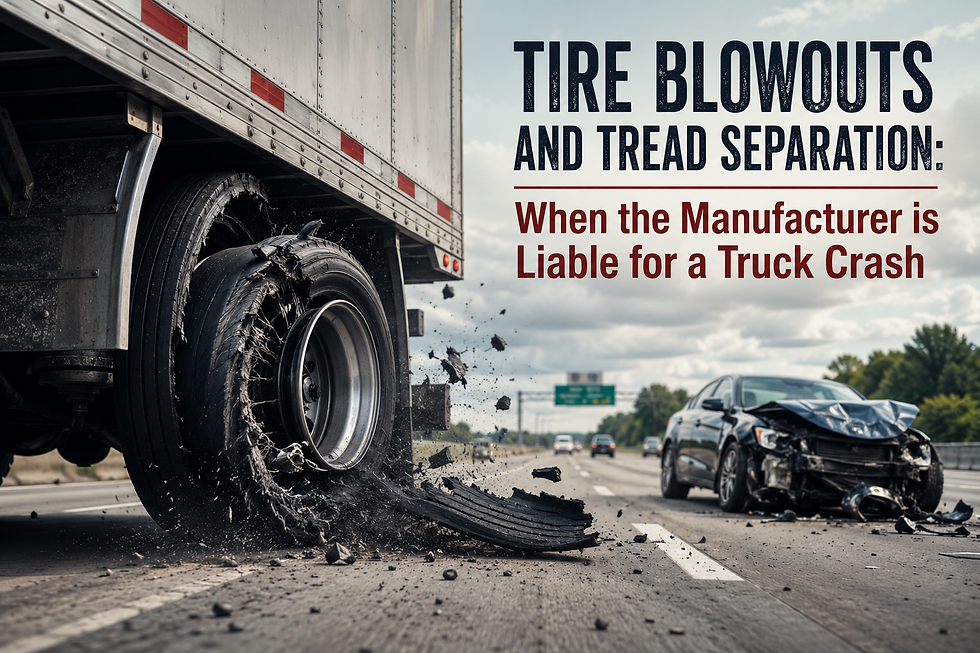
Tire Blowouts and Tread Separation: When the Manufacturer is Liable for a Truck Crash
Last Reviewed: May 8, 2026
Publisher: PI Law News
Author: Peter Geisheker
This article is for informational purposes only and does not constitute legal advice. Truck-accident product liability law varies materially by state and depends entirely on the specific facts of each case. If a defective tire injured you or a family member in a commercial truck crash, consult a licensed attorney in your jurisdiction immediately to evaluate your claim.
The Bottom Line: Tire blowouts and tread separation make the manufacturer liable for a truck crash when a design defect, manufacturing defect, or failure-to-warn defect in the tire itself caused the failure — and that defect caused the crash. Liability rests on product liability law (most states apply strict liability), proven through preserved tire evidence, forensic engineering analysis, and recall or claims-history records. Manufacturer liability is distinct from carrier maintenance liability; serious blowout cases often name both.
Key Facts at a Glance
In 2023, 4,354 people died in large truck crashes in the United States, and 65% of those killed were occupants of passenger vehicles, according to the Insurance Institute for Highway Safety.
The FMCSA's Large Truck Crash Causation Study attributed roughly 5.6%–6% of serious large-truck crashes — about 8,000 crashes a year — primarily to tire problems, including blowouts and tread separation.
Federal regulation 49 CFR 393.75 requires a minimum tread depth of 4/32 inch on steer-axle tires and 2/32 inch on all other commercial-vehicle tires; tires with body-ply or belt material exposed are prohibited from service.
The 2000 Firestone-Ford recall — driven by tread separation on Firestone ATX, ATX II, and Wilderness AT tires — was eventually linked by NHTSA's complaint database to 192 deaths and over 500 injuries as of September 2001, and led directly to the federal TREAD Act of 2000.
The Goodyear G159 commercial tire recall of June 2022 covered roughly 173,279 tires linked to 95 deaths and injuries since 1998, after a multi-year NHTSA investigation that began only when sealed-settlement records were unsealed by a court.
Federal Motor Vehicle Safety Standard FMVSS No. 119 — codified at 49 CFR 571.119 — sets the federal performance, endurance, and strength tests that new commercial-vehicle tires must pass before being sold in the United States.
According to NHTSA tire-related crash data, tire-related issues — including blowouts and tread separation — were tied to roughly 78,392 crashes a year before tire pressure monitoring systems became mandatory in 2007 under FMVSS Nos. 138 and 139.
Get a free case evaluation — a tire-defect attorney can review preserved tire evidence, recall histories, and FMCSA inspection data to determine whether the manufacturer, the carrier, or both share liability.
In This Article
The legal framework: how product liability law treats a defective truck tire
What "tread separation" actually means — and why it points at the manufacturer
The three defect theories: design, manufacturing, and failure to warn
How forensic engineers separate manufacturer fault from maintenance fault
The Firestone-Ford and Goodyear G159 cases and what they teach about manufacturer liability
Federal regulations: FMVSS 119, 49 CFR 393.75, and the TREAD Act
Who else can be liable alongside the tire manufacturer
State-by-state statute of limitations and statute of repose comparison
What evidence you must preserve immediately after a blowout crash
How damages are calculated in a truck tire-defect case
Frequently asked questions about manufacturer liability for tire blowouts

How Does Product Liability Law Apply to a Defective Truck Tire?
Product liability law treats a tire that fails in normal use as a defective product, exposing the manufacturer to strict liability in most states. An injured plaintiff is not required to prove that the tire company was negligent — only that the tire contained a defect, that the defect existed when it left the manufacturer's control, and that the defect caused the crash and the injuries.
The legal foundation traces to the Restatement (Second) of Torts § 402A and decades of state-level case law. The plaintiff's burden in a typical commercial truck tire case is fourfold: (1) the tire was defective; (2) the defect existed when the manufacturer placed the tire in the stream of commerce; (3) the defect was the proximate cause of the crash; and (4) the plaintiff suffered legally compensable damages as a result. According to strict-liability product law as applied in tire cases, the injured party need not show prior knowledge or intent — only that the product failed dangerously when used as intended.
That makes tire-defect cases legally distinct from ordinary truck-accident negligence claims. A negligence claim against a carrier requires proof that the carrier breached a duty of care; a strict-liability claim against a tire manufacturer requires only proof of the defect and causation. Both theories can — and frequently do — proceed simultaneously in the same lawsuit when a blowout case involves both inadequate maintenance and a defective tire.
What Is Tread Separation, and Why Does It Point at the Manufacturer?
Tread separation is a tire failure in which the outer tread layer detaches from the steel-belted casing while the tire is in service, often producing a sudden loss of air pressure, a violent debris field, and a complete loss of vehicle control. It is widely recognized in product liability litigation as the single most common type of tire failure tied to manufacturing defects.
A modern commercial truck tire is built by layering rubber compounds, steel belts, polyester or nylon body plies, and a bead structure, then curing the assembly under heat and pressure. Adhesion between the rubber tread and the steel belt depends on a thin layer of rubber called the belt skim coat, the chemical "tack" of the components when they are assembled, and the cleanliness of the contact surfaces during the build. When tread separation occurs in a tire that was properly maintained and not abused, forensic tire engineers typically look for one or more of these signatures: distorted belt cords, an inadequate skim-coat gauge, "reduced tack and component adhesion" from aged rubber stock, contamination cured into the carcass, and oxidation cracking inside the belt package.
These are not signs of driver error. They are physical fingerprints of how the tire was made — which is why tread separation is the most frequently cited basis in tire-manufacturer product liability lawsuits, including the Firestone ATX and Wilderness AT cases of the early 2000s and the more recent Goodyear G159 commercial tire litigation.
Tread separation represents one of the most dangerous defect categories, occurring when outer rubber layers detach from the tire's internal structure during operation. This sudden failure typically causes drivers to lose vehicle control at highway speeds, resulting in rollovers or collisions.
What Are the Three Manufacturer-Defect Theories in a Truck Tire Case?
A tire manufacturer can be liable under three distinct defect theories: design defect, manufacturing defect, and failure to warn (sometimes called marketing defect). Each theory has a different evidentiary burden, and a single tire failure can implicate more than one.
A design defect exists when every tire of a particular model is unreasonably dangerous as designed — the design itself is the problem, not how a particular tire was built. The Goodyear G159 commercial tire is the textbook example: plaintiffs argued the tire was designed for short-haul delivery service but marketed for use on Class A motorhomes traveling at sustained highway speeds, generating heat the design could not safely dissipate. Internal heat-rise tests cited in litigation showed the tire ran hot at highway speeds — a defect that no level of careful operation could overcome.
A manufacturing defect exists when a particular tire deviates from the manufacturer's own specifications because of an error during production. Examples include contamination cured into the rubber, misaligned or insufficient belt skim coat, distorted belt cords, broken or maladjusted machinery during the cure, and the use of "excessively aged components" that have lost their chemical tack. A federal court in Tennessee summarized the typical expert opinion in this category, noting an expert had attributed a tread separation to "manufacturing defects, including distorted belt cords, insufficient gauge of the belt skim coat, [and] reduced tack and component adhesion caused by the use of excessively aged components" — a reasonably representative list of the physical evidence that distinguishes a manufacturing defect from ordinary wear.
A failure-to-warn defect exists when a tire's design and construction are reasonable but the manufacturer fails to warn users of a known hazard, fails to specify a critical operational limit, or markets the tire for an application it cannot safely perform. Failure-to-warn claims were central to the Goodyear G159 litigation, where plaintiffs alleged the company knew the tire ran dangerously hot at highway speeds and chose not to warn motorhome owners — and chose not to escalate the data to NHTSA — even as injury claims accumulated.
How Do Forensic Engineers Distinguish Manufacturer Fault from Maintenance Fault?
Forensic tire engineers separate manufacturer-defect cases from maintenance cases by physically examining the failed tire — and a "companion" tire from the same vehicle when possible — for specific signatures of each failure mode. The investigation is empirical, not theoretical, and it is the central reason why preserving the tire after a blowout crash is non-negotiable.
In a typical examination, the expert performs a visual inspection, then often supplements with x-ray imaging or shearography of both the failed tire and the companion. Patterns consistent with under-inflation include excessive shoulder wear relative to center wear, a pronounced "bead groove" where the bead has been pushed against the rim, sidewall flexing damage, and discoloration of the inner liner from heat. Patterns consistent with overloading include comparable shoulder wear concentrated on the load-bearing axle. Patterns consistent with road hazard include cuts, punctures, and impact bruising correlated to a specific event. Patterns consistent with manufacturing defect — and not the others — include the belt-cord and skim-coat findings described above, evidence of oxidation cracking inside the belt package, and the recovery of contaminants cured into the rubber.
When the failure is also seen in companion tires manufactured at the same plant during the same week, the case for a systemic manufacturing problem strengthens significantly. Plaintiffs' counsel typically subpoena the manufacturer for a tire from the same plant and production week — what the industry calls a DOT date code match — for direct comparison.
The Firestone-Ford Tread Separation Crisis: The Defining Manufacturer-Liability Case
The August 2000 Bridgestone-Firestone tire recall remains the most consequential tread-separation episode in U.S. legal history. Bridgestone-Firestone announced a recall of approximately 6.5 million Firestone ATX, ATX II, and Wilderness AT tires after a NHTSA investigation linked tread separation on the tires — primarily mounted on Ford Explorer SUVs — to dozens of fatal rollover crashes.
By the time NHTSA released its initial defect determination in 2001, tread-separation complaints associated with the recalled and "focus" tires had been linked to 192 deaths and over 500 injuries. Other contemporaneous estimates put the total death toll above 200. The recall ultimately covered 14.4 million tires after Ford expanded it unilaterally; Bridgestone-Firestone closed its Decatur, Illinois plant — the source of many of the failed tires — and U.S. lawmakers held hearings that produced the Transportation Recall Enhancement, Accountability, and Documentation Act (TREAD Act of 2000).
The legal lessons from Firestone-Ford established the modern playbook for manufacturer liability in tread-separation cases: (1) early, geographically clustered claims data — particularly from hot climates — are powerful evidence of a design or process defect; (2) internal pressure-recommendation disputes between an automaker and a tire maker do not eliminate manufacturer liability; (3) when claims data are systematically settled and sealed, the manufacturer's failure to escalate to regulators can itself become an independent ground for liability and punitive damages.
Speak with a personal injury attorney — a lawyer experienced in tire-defect litigation can pull NHTSA recall and complaint data on the specific tire model and DOT code from the crash and quickly determine whether a known-defect history applies.
The Goodyear G159 Recall: Manufacturer Liability for a Commercial Truck Tire
The Goodyear G159 commercial tire — recalled in June 2022 — illustrates the same playbook applied to a heavy-vehicle context. The G159 was marketed in the 275/70R22.5 size used on commercial delivery trucks, but also installed as original equipment on many Class A motorhomes manufactured between 1996 and 2003.
The recall covered roughly 173,279 G159 tires linked to 95 deaths and injuries since 1998. The NHTSA recall report (22T-009) documents that the agency only opened its formal defect investigation after a private litigant produced sealed records showing tread separation problems in the field. NHTSA explicitly noted that data produced in litigation was sealed under protective orders and confidential settlement agreements, precluding claimants from submitting it to the agency.
A 2010 jury verdict awarded $5.6 million to a family seriously injured when a G159 failed at highway speed on a motorhome. According to plaintiffs' counsel in subsequent litigation, the company's strategy of obtaining protective orders and confidential settlements delayed regulatory action by years, costing additional lives. For purposes of this article, the relevant point is the legal one: a tire manufacturer can be held liable not only for the defect itself but for the way it manages the post-sale claims and warning process when a defect emerges.
What Federal Regulations Govern Commercial Truck Tires?
The federal framework regulating commercial truck tires combines vehicle-equipment standards (which the manufacturer must meet at the time of sale) with motor-carrier safety standards (which the carrier and driver must meet during operation). Both tracks matter to a manufacturer-liability case because they establish the duty owed.
On the manufacturing side, FMVSS No. 119, codified at 49 CFR 571.119, sets performance, endurance, strength, and labeling requirements for new pneumatic tires built for vehicles with a gross vehicle weight rating above 10,000 pounds. FMVSS No. 119 includes a 47-hour endurance test and a strength test, and was the focus of the post-Firestone TREAD Act revisions. FMVSS No. 120 (49 CFR 571.120) requires vehicle manufacturers to equip new commercial vehicles with tires and rims that match the vehicle's load and inflation requirements.
On the operational side, 49 CFR 393.75 sets the field-condition standards every commercial vehicle must meet at any moment of operation: no body-ply or belt material exposed; no tread or sidewall separation; no audible air leak; minimum 4/32 inch tread on steer-axle tires; minimum 2/32 inch on all other tires; and tightly limited use of regrooved or retreaded tires on the steering axle of trucks and tractors.
When a blowout occurs and the post-crash measurement shows the tire was below 49 CFR 393.75 minimums, that is negligence per se against the carrier — but it does not necessarily exonerate the manufacturer. A defect-bearing tire that also fell below tread minimums simply produces overlapping liability.
Who Else Can Be Liable Alongside the Tire Manufacturer?
A truck blowout case rarely names the manufacturer alone. Depending on the facts, additional defendants commonly include the carrier, the driver, the retreader, the maintenance shop, the cargo shipper, and sometimes the vehicle manufacturer.
The motor carrier is liable when its maintenance program failed to detect a worn, damaged, or expired tire — for example, when post-crash inspection shows the tire was below 4/32 inch on the steer axle, or when maintenance logs show the tire was overdue for replacement. The driver is liable when a pre-trip inspection that should have caught a visible defect was not performed or was performed inadequately; FMCSA requires daily driver vehicle inspection reports (DVIRs) under 49 CFR 396.11. The retreader is liable in a strict-liability frame when a retreaded tire fails because of a defective retread bond — many carriers run retreads on trailer axles for cost reasons, which makes retread quality a recurring liability issue.
A maintenance shop is liable when an outside service installed an incorrect, recalled, or improperly mounted tire. The cargo shipper is liable when a load that exceeded gross axle weight ratings caused or contributed to the failure; FMCSA load enforcement records and weigh-station data become evidence in those cases. The truck manufacturer can be co-liable when an original-equipment fitment combined a particular tire and vehicle in a way that produced predictable failure — the Firestone-Ford case is the canonical example.
Coordinating these claims is one of the central tasks for the truck accident attorney handling the case. Each defendant has its own insurance carrier, its own discovery burden, and its own theory of comparative fault — which is why serious blowout cases routinely take 18 to 36 months to resolve.
How Does the Statute of Limitations Affect a Tire Defect Claim?
Every state imposes a deadline — the statute of limitations — by which a product-liability lawsuit must be filed, and many states impose an additional statute of repose that bars claims brought after a fixed period from the product's first sale, regardless of when the injury occurred. Missing either deadline typically extinguishes the claim entirely.
The statute of limitations for product liability is most commonly two years from the injury date or the date the defect was reasonably discovered. A handful of states, including Maine and Minnesota, allow up to six years. The discovery rule — the doctrine that the limitations clock starts when the injury and its cause are reasonably known — is recognized in most states for product liability claims, but its scope varies.
Statutes of repose are the more dangerous trap. Several states bar product liability claims for a fixed number of years after the product was first sold, without regard to when the harm occurred. Nebraska, for example, codifies a 10-year repose period; the Nebraska Supreme Court has held in Gillam v. Firestone Tire & Rubber Co., 241 Neb. 414 that an injury occurring outside the 10-year window produces no actionable claim. Tires manufactured many years before a crash — including older retreaded tires — can fall outside the repose period in those states, even when the defect is clear.
Statutes change. Confirm the controlling deadline with a licensed attorney in the jurisdiction where the crash occurred — this table is a starting point, not legal advice.
What Evidence Must Be Preserved After a Tire-Failure Truck Crash?
The single most important post-crash decision in any tire-failure case is preserving the failed tire and the vehicle in their post-accident condition. A scrapped tire is a destroyed case.
The minimum evidence preservation list includes: (1) the failed tire — every fragment, every belt, every recovered piece of tread; (2) the companion tire on the same axle; (3) the tire on the opposite axle position when possible; (4) the rim and wheel; (5) the entire vehicle, with no repairs and no insurer-driven scrap; (6) all FMCSA-mandated maintenance records, including driver vehicle inspection reports, annual inspections, and tire-replacement invoices; (7) the truck's electronic logging device data and any event data recorder data; (8) photographs of the crash scene including debris-field locations; (9) the police accident report; and (10) every witness contact.
The tire itself should be preserved indoors, out of sunlight, and untouched until a qualified forensic engineer can examine it. Insurers and salvage yards routinely scrap evidence within days of a serious crash — sometimes hours. Counsel should send written preservation-of-evidence demands ("litigation hold letters") to every entity with custody of the relevant evidence on the day of retention.
A skilled defective-tire attorney will also pull NHTSA's complaint and recall databases for the tire's model and DOT date code, request the manufacturer's claim database in discovery, and subpoena a comparison tire from the same plant and production week.
How Are Damages Calculated in a Truck Tire Defect Case?
Damages in a successful tire-manufacturer claim follow standard personal injury and wrongful death categories — but the magnitude is typically larger than in ordinary motor-vehicle cases because commercial truck blowouts produce catastrophic injuries at disproportionate rates.
Economic damages include past and future medical expenses (often including life-care plans for catastrophic injury), past and future lost earnings, lost earning capacity, vehicle and property damage, and the cost of vocational retraining where the injured person can no longer perform pre-crash work. Non-economic damages include pain and suffering, loss of enjoyment of life, disfigurement, and — in wrongful death actions — loss of consortium, society, and support to surviving family members. Punitive damages are available in many jurisdictions when the manufacturer's conduct meets the state's standard for gross negligence, recklessness, or willful misconduct. Evidence of suppressed claims data, ignored internal warnings, or known-defect inaction (the pattern at the heart of both Firestone-Ford and Goodyear G159) is the typical basis for punitive exposure in tire cases.
Many states cap non-economic and/or punitive damages, but the caps vary widely. Texas caps punitive damages at the greater of 2x economic damages plus non-economic damages up to $750,000, or $200,000 (Tex. Civ. Prac. & Rem. Code § 41.008). California has no statutory cap on punitive damages but applies the constitutional due process limits the U.S. Supreme Court announced in BMW v. Gore and State Farm v. Campbell. Florida caps punitive damages at the greater of 3x compensatory damages or $500,000 in most cases. Calculating the realistic recovery range in a specific case is one of the first tasks a tire-defect attorney handles in evaluation.
Contact us for a free consultation — early case evaluation often determines whether evidence can still be preserved and whether the claim falls within the controlling statute of limitations and repose.
Frequently Asked Questions About Tire Manufacturer Liability for Truck Crashes
Who is liable for a truck accident caused by a tire blowout?
Liability for a truck accident caused by a tire blowout depends on what made the tire fail. If a manufacturing defect, design defect, or failure-to-warn defect in the tire itself caused the failure, the tire manufacturer is liable under product liability law. If poor maintenance, missed pre-trip inspection, overloading, or running the tire below 49 CFR 393.75 tread minimums caused the failure, the carrier and/or driver are liable under negligence law. Many serious cases involve overlapping liability — the tire was defective and the carrier failed to maintain it — and name multiple defendants.
Once the failed tire is forensically examined and the maintenance records and DVIRs are reviewed, the liability picture usually clarifies. Recovery often proceeds against the carrier, the driver, the manufacturer, and (where applicable) the retreader simultaneously, with the jury or a settlement allocation dividing fault.
Can you sue a tire manufacturer for a tire blowout?
Yes. A tire manufacturer can be sued for a blowout under product liability law in every U.S. state when the failure was caused by a defect in the tire's design, manufacture, or warnings. Most states apply strict liability to product cases, which means the plaintiff does not need to prove the manufacturer was negligent — only that the tire was defective and that the defect caused the crash and the injuries.
Tire manufacturer claims are technical and fact-intensive. They require a preserved tire, a forensic engineer, recall and complaint database review, and (in many cases) discovery of the manufacturer's internal claims data and design-test history. They are also subject to strict statutes of limitations and statutes of repose that vary by state. Engaging a defective-tire attorney quickly is critical to preserve both the evidence and the legal claim.
How do you prove a tire was defective after an accident?
A tire is proven defective through forensic engineering examination of the failed tire combined with documentary evidence about its design, manufacture, and field history. The forensic exam looks for physical signatures of each failure mode: distorted belt cords, inadequate skim coat, oxidation cracking, contamination, and reduced component adhesion all point at manufacturing defects, while excessive shoulder wear, bead-groove formation, and inner-liner heat damage point at under-inflation or maintenance failures.
The documentary evidence — NHTSA recall and complaint records for the tire model and DOT date code, the manufacturer's internal claim database, design-test files, and quality-control records from the production plant — establishes whether the failure was systemic or isolated. A tire-defect attorney coordinates the engineering exam with the discovery process and aligns expert testimony with the documentary record at trial.
What is tread separation and what causes it?
Tread separation is the failure mode in which the tread layer of a tire detaches from the steel-belted casing while the tire is in service. It produces a sudden loss of vehicle control, often a debris field across multiple lanes, and frequently a rollover when it occurs on a high-center-of-gravity vehicle like an SUV or a Class A motorhome.
Tread separation is caused by failed adhesion between the tread/belt package and the casing. The most common causes are manufacturing defects in the belt skim coat, contamination cured into the rubber during production, "aged components" with reduced chemical tack, oxidation inside the belt package, design defects that produce excessive heat at sustained highway speeds, prolonged operation of an under-inflated tire, and (for retreaded tires) defective retread bonding. A forensic engineer can usually distinguish among these causes by physical inspection of the failed tire.
Is a truck tire blowout an at-fault accident?
A truck tire blowout is generally treated as an at-fault accident for the carrier and driver in the absence of proven manufacturer defect, because federal regulations require the carrier to maintain tires above the 49 CFR 393.75 minimums and the driver to perform pre-trip inspections. A blowout in a tire that was below the regulatory tread minimum or that showed pre-existing damage that should have been caught during inspection establishes negligence per se against the carrier and driver.
When forensic examination reveals a manufacturing or design defect that the carrier could not reasonably have detected on inspection, the manufacturer takes a substantial share of fault — and in some cases all of it. The fault allocation is rarely binary; modern truck blowout cases routinely produce comparative-fault findings that split liability among the manufacturer, the carrier, and the driver.
What are the most common causes of truck tire blowouts?
The most common causes of commercial truck tire blowouts are, in order: (1) under-inflation, which generates heat and accelerates internal degradation; (2) overloading, which puts more weight on the tire than its load rating supports; (3) inadequate maintenance, including running tires below FMCSA minimum tread depth or with visible damage; (4) road hazards and impact damage; (5) manufacturing defects in the tire; (6) design defects in the tire (less common but more catastrophic when present); and (7) defective retread bonding on retreaded tires.
Federal data from FMCSA's Large Truck Crash Causation Study attributes roughly 8,000 serious large-truck crashes each year primarily to tire problems — about 5.6%–6% of the total. Most of these involve the carrier-side causes; defect-driven failures are a smaller subset, but they are disproportionately represented in catastrophic-injury and wrongful-death cases.
How long do you have to file a tire defect lawsuit?
Filing deadlines for tire defect lawsuits are set by state law and are typically two years from the date of injury or the date the defect was reasonably discovered, though some states allow up to six years. In addition to the statute of limitations, many states impose a statute of repose that bars product liability claims a fixed number of years after the product's first sale, independent of when the injury occurred — for example, 10 years in Nebraska and Georgia and 15 years in Texas.
Because both deadlines apply, and because the tire's manufacture date is often years before the crash, a defect claim that looks viable on the surface can be barred by the repose statute when measured against the date the tire was first sold. Consulting a defective-tire attorney within weeks — not months — of the crash is critical to confirm both deadlines, preserve the physical evidence, and file before the clock runs out. Discuss your case at no cost — early review preserves both the evidence and the legal claim.
What evidence do I need for a tire defect claim?
The essential evidence for a tire defect claim is the failed tire itself, preserved in its post-accident condition, plus all of the following: the companion tire from the same axle; photographs of the crash scene, debris field, and tire fragments; the police accident report; the truck's electronic logging device and event data recorder downloads; the carrier's maintenance records and driver vehicle inspection reports for the tire and vehicle; the bill of lading and weight tickets if overloading is suspected; the tire's DOT date code; medical records establishing causation between the crash and the injuries; and witness contact information.
Beyond the case-specific evidence, a defect claim relies on industry-wide records — NHTSA recall notices and complaint data for the tire model and DOT date code, the manufacturer's internal claim database obtained in discovery, design-test files, and (when available) quality-control records from the production plant. A tire-defect attorney coordinates the case-specific evidence preservation with the broader industry-evidence subpoenas and discovery requests.
Are retreaded truck tires more likely to fail?
Retreaded tires fail at higher rates than new tires when the retread bond is defective, but a properly retreaded commercial-grade tire performs comparably to a new tire in many service conditions. Retreaded tires are prohibited on the steering axle of buses under FMCSA regulations and are practically restricted on the steer axle of trucks and tractors by 49 CFR 393.75(d) and (e). They are widely used on trailer axles to control cost.
When a retreaded tire fails because of a defective retread bond, the retreader can be held liable under the same product liability theories that apply to original tire manufacturers. Retreaded-tire failures are also more difficult to forensically diagnose than original-tire failures because the retread layer obscures the tire's history; preservation of the entire failed tire is especially important in retread cases.
How is a manufacturer-liability claim different from a negligence claim against the trucking company?
A manufacturer-liability claim is a strict liability claim — the plaintiff need only prove the tire was defective and the defect caused the harm. A negligence claim against a trucking company requires the plaintiff to prove that the carrier breached a duty of care (usually under the FMCSA regulations) and that the breach caused the harm. The legal burden, the discovery focus, and the evidence base are different.
In practice, both claims often proceed in the same lawsuit. The manufacturer claim focuses on the failed tire, design and manufacturing records, and recall and complaint history. The carrier claim focuses on FMCSA inspection records, driver qualification files, hours-of-service logs, maintenance records, and the carrier's safety culture more broadly. A jury or a settlement allocation typically apportions fault between the manufacturer and the carrier based on the comparative weight of the evidence on each track.
Authoritative References
Insurance Institute for Highway Safety. "Fatality Facts 2023: Large Trucks." https://www.iihs.org/research-areas/fatality-statistics/detail/large-trucks
Federal Motor Carrier Safety Administration. "Large Truck and Bus Crash Facts." https://www.fmcsa.dot.gov/safety/data-and-statistics/large-truck-and-bus-crash-facts
Federal Motor Carrier Safety Administration. "The Large Truck Crash Causation Study — Analysis Brief." https://www.fmcsa.dot.gov/safety/research-and-analysis/large-truck-crash-causation-study-analysis-brief
Electronic Code of Federal Regulations. "49 CFR 393.75 — Tires." https://www.ecfr.gov/current/title-49/subtitle-B/chapter-III/subchapter-B/part-393/subpart-G/section-393.75
Federal Register. "Federal Motor Vehicle Safety Standards; New Pneumatic Tires for Motor Vehicles With a GVWR of More Than 4,536 Kilograms (10,000 Pounds) and Motorcycles." https://www.federalregister.gov/documents/2010/09/29/2010-24347/federal-motor-vehicle-safety-standards-new-pneumatic-tires-for-motor-vehicles-with-a-gvwr-of-more
National Highway Traffic Safety Administration. "Tire-Related Factors in the Pre-Crash Phase (DOT HS 811 617)." https://crashstats.nhtsa.dot.gov/Api/Public/ViewPublication/811617
National Highway Traffic Safety Administration. "Consumer Alert: Goodyear Issues Recall for Select Tires Used on RVs." https://www.nhtsa.gov/press-releases/goodyear-recall-tires-rvs
National Highway Traffic Safety Administration. "Part 573 Safety Recall Report 22T-009 — Goodyear G159." https://static.nhtsa.gov/odi/rcl/2022/RCLRPT-22T009-6772.PDF
Center for Auto Safety. "Ford Explorer-Firestone Tire." https://www.autosafety.org/ford-explorer-firestone-tire/
National Highway Traffic Safety Administration. "EA00-023: Firestone Wilderness AT Tires (Initial Decision)." https://www.nhtsa.gov/sites/nhtsa.gov/files/firestonereport.pdf
Federal Register. "Federal Motor Vehicle Safety Standards; Tires (TREAD Act revisions)." https://www.federalregister.gov/documents/2019/12/19/2019-27209/federal-motor-vehicle-safety-standards-tires
Nebraska Legislature. "Statute 25-224 (Product Liability Statute of Repose)." https://nebraskalegislature.gov/laws/statutes.php?statute=25-224
Applied Technical Services. "Tire Failure Expert — Forensic Investigation Methodology." https://atslab.com/forensics/expert-witness/tire-failure-expert/
Editorial Standards & Review
PI Law News produces consumer legal information about commercial truck accidents and personal injury law in the United States. Every article on this site follows a documented editorial process: claims that quantify (statistics, dollar figures, deadlines, regulatory thresholds) are sourced to original government, peer-reviewed, or trade-association publications and linked inline to the source URL; legal citations are verified against the official federal or state code; recall and case-history references are verified against NHTSA and court records.
Articles are educational and do not constitute legal advice. Personal injury law varies substantially by state, and the outcome of any specific case depends on its specific facts. Readers facing a potential claim should consult a licensed attorney in their state. PI Law News is published by Peter Geisheker — Founder and CEO of The Geisheker Group, Inc. — who writes about personal injury topics from the perspective of more than two decades of marketing and case-acquisition work for plaintiffs' law firms across the U.S. The publisher is not a practicing attorney.
Last reviewed: May 2026.


