
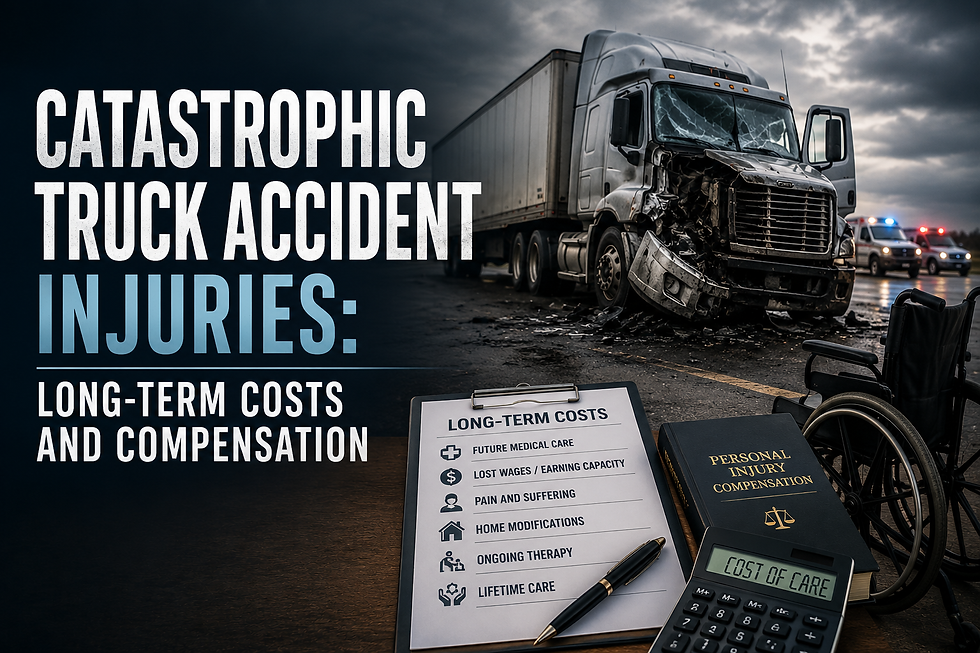
Catastrophic Truck Accident Injuries: Long-Term Costs and Compensation
Last Reviewed: 2026-05-24
Publisher: PI Law News
Author: Peter Geisheker
This article is for informational purposes only and does not constitute legal or medical advice. If you have been injured in a truck accident, consult a licensed attorney in your state and seek care from a qualified medical provider.
A catastrophic truck accident causes a permanent, life-altering injury — most often a traumatic brain injury, spinal cord paralysis, amputation, or severe burns — that ends a victim's ability to work or live independently. Lifetime costs for the most severe spinal cord injuries exceed $5 million, which is why these claims are valued on decades of future care and lost earnings, not just the bills already received.
Key Facts at a Glance
In 2023, 4,354 people died in large-truck crashes in the United States, and 65% of them were occupants of passenger vehicles rather than the truck, according to the Insurance Institute for Highway Safety.
About 18,000 new traumatic spinal cord injuries occur in the United States each year, with motor vehicle crashes the leading cause, per the National Spinal Cord Injury Statistical Center.
Between 257,000 and 388,000 people were living with a traumatic spinal cord injury in the United States in 2023, according to the National Spinal Cord Injury Statistical Center.
First-year medical costs for high (C1–C4) tetraplegia exceed $1 million, with several hundred thousand dollars in costs every year afterward, based on NSCISC Facts and Figures data.
Indirect costs alone — lost wages, benefits, and productivity — averaged $82,329 per year in 2021 dollars for spinal cord injury survivors, per the NSCISC / MSKTC data sheet.
In 2023, 5,375 large trucks were involved in fatal crashes, and large-truck fatal crashes rose 43% over the prior decade, according to the FMCSA.
49% of people killed inside large trucks in 2023 died in crashes where the truck rolled over, a leading mechanism of catastrophic injury, per the Insurance Institute for Highway Safety.
A crash with a fully loaded tractor-trailer is not a larger version of a car accident. It is a different category of event. When up to 80,000 pounds strikes a 4,000-pound passenger vehicle, the people in the smaller vehicle absorb forces their bodies were never built to survive. In 2023, 4,354 people died in large-truck crashes, and 65% of them were riding in passenger vehicles, according to the Insurance Institute for Highway Safety. Those who live often face permanent, life-altering injuries.
Those permanent injuries are what the law calls catastrophic. A catastrophic truck accident injury changes not just the next few months but the next several decades, ending a victim's ability to work, to move freely, or to live without daily assistance. The medical and financial weight of that reality is staggering, and it is almost never reflected in an insurance company's first settlement offer.
This article explains what counts as a catastrophic truck accident injury, why these crashes produce such severe harm, what the injuries cost over a lifetime, and how a claim is valued and proven. The central theme is simple: a catastrophic case is about the future, not the past. The bills already received are a small fraction of what a complete claim must account for.
If you are reading this for yourself or for an injured family member, the most important takeaway is that the true value of a catastrophic claim is measured in decades of care. Understanding that is the first step toward a recovery that actually covers a lifetime.
In this article:
What counts as a catastrophic truck accident injury
Why truck crashes cause such severe injuries
The most common catastrophic injuries
Lifetime costs of a catastrophic injury
What damages a victim can recover
How a catastrophic claim is valued
Who can be held liable
Why these cases need expert witnesses
How long you have to file
What to do after a catastrophic crash
What Is Considered a Catastrophic Truck Accident Injury?
A catastrophic truck accident injury is one that permanently impairs a person's ability to work or live independently. Unlike injuries that heal with time, a catastrophic injury produces lasting disability that requires long-term medical care, rehabilitation, and often lifelong assistance.
The category is defined by permanence and severity, not by a single diagnosis. Courts and life care planners treat an injury as catastrophic when it causes paralysis, permanent cognitive impairment, loss of a limb, loss of a major bodily function, or disfigurement that prevents a return to the victim's prior life. The defining question is whether the person can ever recover the independence and earning capacity they had before the crash.
This distinction drives the entire claim. A recoverable injury is valued on a finite course of treatment. A catastrophic injury is valued on a lifetime of treatment, which is why these cases sit at the very top of the personal injury value scale and why insurers fight so hard to minimize them.
Why Are Truck Accidents So Likely to Cause Catastrophic Injuries?
Truck accidents cause catastrophic injuries because of physics: a commercial truck can weigh 20 to 30 times more than a passenger car, and that mass translates into enormous destructive force in a collision. The occupants of the smaller vehicle have no structural protection against that disparity.
The federal data shows how lopsided the outcomes are. In 2023, 65% of those killed in large-truck crashes were occupants of passenger vehicles, and 49% of the people who died inside large trucks were in crashes where the truck rolled over, per the Insurance Institute for Highway Safety. Rollover, underride, and high-speed override crashes are mechanisms almost unique to large trucks, and each one produces severe head, spine, and crush injuries.
The trend is also moving the wrong way. The FMCSA reports that 5,375 large trucks were involved in fatal crashes in 2023, and that large-truck fatal crashes rose 43% over the prior decade. More large trucks in fatal crashes means more catastrophic, survivable injuries among the people they hit.
What Are the Most Common Catastrophic Injuries in Truck Crashes?
The most common catastrophic injuries in truck crashes are traumatic brain injury, spinal cord injury, traumatic amputation, severe burns, and internal organ damage. Because of the forces involved, a single victim frequently suffers more than one of these at the same time.
Traumatic brain injury (TBI) occurs when the head's violent motion drives the brain against the skull, causing bleeding such as a subarachnoid hemorrhage, diffuse axonal injury, or permanent cognitive and personality changes. Spinal cord injury (SCI) ranges from incomplete injury with partial function to complete injury causing paraplegia or, with damage at the C1\u2013C4 cervical levels, high tetraplegia affecting all four limbs and breathing.
The remaining categories are equally life-altering. Traumatic amputation, whether at the scene or surgically required afterward, ends limb function permanently. Severe burns from fuel spills or cargo cause disfigurement and require years of reconstructive surgery. Internal organ damage and multiple complex fractures often accompany these injuries, lengthening hospitalization and adding to the lifetime cost.
How Common Are Catastrophic Spinal Cord and Brain Injuries?
Catastrophic spinal cord and brain injuries are far from rare, and motor vehicle crashes are a leading cause of both. The scale of the problem is documented by the National Spinal Cord Injury Statistical Center, which has tracked these injuries through a federally funded database since 1973.
The figures below frame how common these injuries are and who they affect. They also explain why crashes involving large trucks, which concentrate extreme force on the spine and head, are such a significant contributor.
Measure | Figure | Source |
New traumatic spinal cord injuries per year (US) | About 18,000 | |
People living with spinal cord injury (US, 2023) | 257,000 to 388,000 | |
Leading cause of new spinal cord injuries | Motor vehicle crashes | |
Average age at injury | About 43 years | |
Share of new cases since 2015 that are male | About 78% |
These numbers matter to a claim because they establish that catastrophic outcomes are a known, foreseeable consequence of commercial-vehicle crashes, not a freak result. They also identify the working-age victims, often in their prime earning years, whose lost earning capacity becomes a central element of damages.
How Much Do Catastrophic Truck Accident Injuries Cost Over a Lifetime?
Catastrophic injuries cost millions of dollars over a lifetime, with the most severe spinal cord injuries exceeding $5 million in direct and indirect costs. The first year is by far the most expensive, driven by emergency transport, trauma surgery, intensive care, and inpatient rehabilitation, after which annual costs continue indefinitely.
The National Spinal Cord Injury Statistical Center at the University of Alabama at Birmingham publishes the standard cost estimates by injury severity. The table below summarizes those figures; all are estimates that rise with inflation and vary by individual case.
Injury level | Estimated first-year cost | Estimated each year after | Source |
High tetraplegia (C1\u2013C4) | Over $1,000,000 | Roughly $185,000\u2013$200,000 | |
Low tetraplegia (C5\u2013C8) | About $770,000 | Roughly $113,000 | |
Paraplegia | About $520,000 | Roughly $69,000 | |
Incomplete motor function (any level) | About $350,000 | Roughly $42,000 | |
Indirect costs (lost wages, benefits, productivity) | \u2014 | About $82,329 per year (2021 dollars) |
These figures are why estimates of how much truck accident settlements are worth climb so high for catastrophic injuries. A 25-year-old with high tetraplegia can face lifetime costs exceeding $5 million in direct care alone, before lost earnings are even counted.
What Long-Term Care Does a Catastrophic Injury Require?
A catastrophic injury requires a coordinated, lifelong system of care that extends far beyond the initial hospital stay. The first year covers emergency surgery, intensive care, and inpatient rehabilitation, but the decades that follow carry their own continuous costs.
For a spinal cord injury, ongoing needs typically include attendant or skilled nursing care, durable medical equipment such as power wheelchairs and ventilators, repeated equipment replacement as devices wear out, home modifications like ramps and roll-in showers, an accessible vehicle, and management of secondary complications such as pressure injuries, urinary infections, and respiratory disease. The NSCISC data shows that these secondary conditions are leading causes of rehospitalization and reduced life expectancy.
For a traumatic brain injury, long-term care often includes cognitive and behavioral therapy, supervision or assisted living, medication management, and vocational support. Because these needs change over a lifetime, the care plan is not a fixed list but a projection that must anticipate decline, equipment turnover, and new complications, which is exactly what makes professional life care planning indispensable to valuing the claim.
What Damages Can a Catastrophic Injury Victim Recover?
A catastrophic injury victim can recover economic damages, non-economic damages, and, in cases of egregious misconduct, punitive damages. Together these are meant to make the victim whole for both measurable losses and the human cost of the injury.
Economic damages cover everything with a price tag: past and future medical care, the full life care plan, lost wages, lost future earning capacity, home and vehicle modifications, and assistive technology. For a catastrophic injury, future damages dwarf past ones, because the most expensive care lies ahead.
Non-economic damages compensate for pain and suffering, permanent disability, disfigurement, and loss of enjoyment of life. In the most serious cases, where a trucking company knowingly disregarded safety rules, punitive damages may be available to punish that conduct. Because a single insurance policy may not cover a multimillion-dollar claim, identifying every recovery source is essential; if you are unsure what your claim should include, discuss your case at no cost with an attorney.
How Is the Value of a Catastrophic Truck Accident Claim Determined?
The value of a catastrophic claim is determined by building a complete, evidence-based projection of lifetime losses and matching it against the available insurance coverage. This is a structured process, not a guess, and it is where catastrophic cases are won or lost.
The core document is the life care plan, a medically based projection of every future cost across the victim's life expectancy, prepared by a certified life care planner. An economist then reduces those future costs to present value and calculates lost earning capacity. A vocational expert assesses whether and how the victim can work again. These projections become the demand figure.
Coverage is the other half of the equation. Federal law requires interstate carriers to hold between $750,000 and $5 million in liability insurance depending on cargo, but catastrophic costs often exceed even the high end, which is why lawyers pursue every liable party and every applicable policy. Understanding how truck accident settlement value is calculated starts with this combination of projected loss and available coverage.
Who Can Be Held Liable in a Catastrophic Truck Crash?
Liability in a catastrophic truck crash usually extends well beyond the driver. Because federal regulations impose duties on many parties in the trucking chain, several defendants may share responsibility, and each is a separate source of insurance.
The potentially liable parties include the driver, the motor carrier that employed and dispatched the driver, the company responsible for vehicle maintenance, the manufacturer of a defective truck or component, the company that loaded or secured the cargo, and sometimes the freight broker. A crash caused by a tire failure, for example, may implicate the carrier for poor maintenance and the tire manufacturer for a product defect.
Identifying every defendant is not a technicality. In a claim valued in the millions, a single driver's coverage is rarely enough, so the recovery often depends on reaching the carrier and any additional responsible companies. This is the same multi-defendant analysis that governs liability in no-zone and blind-spot trucking collisions and other complex truck cases.
The motor carrier's liability deserves particular attention. Under the legal doctrine of respondeat superior, an employer is responsible for the negligent acts of an employee performed within the scope of employment, which makes the carrier liable for its driver's conduct on the job. Separately, a carrier owes its own direct duties, such as careful hiring, training, supervision, and maintenance, that it cannot delegate away. A carrier that hired an unqualified driver or pressured drivers to violate hours-of-service limits can therefore be liable both for the driver's negligence and for its own.
Why Do Catastrophic Truck Cases Require Expert Witnesses?
Catastrophic truck cases require expert witnesses because the damages and the liability are both too complex to prove through documents alone. The size of the claim makes expert support a necessity, not a luxury.
On damages, a treating physician explains the injury and prognosis, a certified life care planner projects future needs, and an economist prices those needs and the lost earnings over a lifetime. Without this testimony, future damages, the largest part of the claim, cannot be established to the standard a court requires.
On liability, an accident reconstructionist explains how the crash happened, and trucking-safety experts interpret the carrier's compliance records and electronic logging data. Insurers employ their own experts to attack every projection, so a victim who proceeds without comparable expert support is negotiating at a structural disadvantage against a defense built to minimize the claim.
How Long Do You Have to File a Catastrophic Truck Accident Claim?
You generally have between one and four years to file a catastrophic truck accident claim, but the exact deadline is set by your state's statute of limitations and the type of claim. Missing the deadline almost always bars the claim permanently, regardless of how strong it is.
The clock usually starts on the date of the crash for a personal injury claim, and on the date of death for a wrongful death claim. Some states apply a shorter deadline when a government entity is involved, such as a publicly owned vehicle, and these can require formal notice within months.
Even where the deadline is years away, waiting is dangerous in a catastrophic case. The compliance records that prove liability can be destroyed on a routine schedule, and the life care planning needed to value the claim takes time to develop. Acting early protects both the evidence and the deadline.
What Should You Do After a Catastrophic Truck Accident?
After a catastrophic truck accident, the priorities are medical care, evidence preservation, and avoiding any early settlement before the full injury picture is known. Each step protects both the victim's health and the value of the claim.
First, follow all recommended medical treatment and keep complete records; gaps in treatment are used by insurers to dispute the severity of an injury. Second, ensure the trucking company's evidence is preserved through a prompt legal demand, because electronic logs, maintenance files, and the truck itself can be altered or lost. Third, do not accept an early settlement offer.
The reason for caution is the future-cost problem. A catastrophic injury's true cost is not known in the first weeks, and an early offer is almost always a fraction of the lifetime figure. Many victims also worry about affording a lawyer, but truck accident cases are typically handled on a contingency-fee basis, meaning no fee is owed unless the case recovers compensation.
Frequently Asked Questions
What is considered a catastrophic injury?
A catastrophic injury is one that permanently impairs a person's ability to work or live independently. In truck crashes, the most common catastrophic injuries are traumatic brain injury, spinal cord injury causing paralysis, amputation, severe burns, and multiple-organ or internal trauma. These injuries require lifelong medical care and produce the highest-value personal injury claims.
How much is a catastrophic truck accident settlement worth?
Catastrophic truck accident claims are valued on lifetime costs, which routinely reach into the millions. First-year medical costs for high tetraplegia exceed $1 million per NSCISC data, and lifetime costs for the most severe spinal cord injuries exceed $5 million. Final value depends on injury severity, future-care needs, lost earning capacity, liability strength, and available insurance coverage.
What are the most common catastrophic truck accident injuries?
The most common catastrophic injuries in truck crashes are traumatic brain injury, spinal cord injury resulting in paraplegia or tetraplegia, traumatic amputation, severe burns from fuel or cargo, and internal organ damage. The force of an 80,000-pound truck striking a passenger vehicle frequently causes more than one of these injuries at once.
How long do you have to file a catastrophic truck accident claim?
The deadline is set by your state's statute of limitations, which generally ranges from one to four years from the date of the crash for a personal injury claim. Because catastrophic cases require extensive evidence preservation and expert work, you should consult an attorney quickly rather than waiting until the deadline approaches. A government-owned vehicle can shorten the time to act significantly.
What is a life care plan in a catastrophic injury case?
A life care plan is a detailed, medically based projection of every future cost a catastrophically injured person will incur: surgeries, therapy, medications, assistive equipment, home modifications, and personal or skilled attendant care across their life expectancy. Prepared by a certified life care planner and priced by an economist, it is the foundation for valuing future damages.
Can you get punitive damages in a truck accident case?
Yes, in many states. Punitive damages are available when a trucking company or driver acted with gross negligence or reckless disregard for safety, such as knowingly using a fatigued driver, falsifying logs, or keeping a truck with known defects in service. They are awarded to punish misconduct and can substantially exceed compensatory damages.
Who pays for lifetime medical care after a catastrophic truck accident?
When another party's negligence caused the crash, that party and its insurer are responsible for future medical care through the damages award or settlement. Federal law requires interstate trucking companies to carry between $750,000 and $5 million in liability coverage, and additional defendants and policies are often pursued to fund the full cost of lifetime care.
Why are truck accident injuries so much more severe than car accident injuries?
Truck accident injuries are more severe because a loaded commercial truck can weigh 20 to 30 times more than a passenger car, and that mass produces far greater destructive force. Crash mechanisms common to large trucks, including rollover and underride, concentrate that force on the occupants of the smaller vehicle, which is why so many truck-crash survivors suffer catastrophic, permanent harm.
Authoritative References and Sources
Insurance Institute for Highway Safety \u2014 Fatality Facts: Large Trucks
National Spinal Cord Injury Statistical Center (NSCISC), University of Alabama at Birmingham
NSCISC \u2014 Frequently Asked Questions (incidence and prevalence)
NSCISC / MSKTC \u2014 Spinal Cord Injury Facts and Figures at a Glance Data Sheet
NSCISC \u2014 Traumatic Spinal Cord Injury Facts and Figures (2025 Data Sheet)
Centers for Disease Control and Prevention \u2014 Transportation Safety
National Institutes of Health \u2014 Economic Impact of Spinal Cord Injury (PMC)
eCFR \u2014 49 CFR Part 387, Minimum Levels of Financial Responsibility for Motor Carriers
Editorial Standards and Review
This article was researched and written to PI Law News editorial standards. Every statistic and cost figure is traced to a primary or authoritative source, cited inline and listed in the references above. Crash data is cited to the Insurance Institute for Highway Safety and the FMCSA; injury incidence, prevalence, and cost data is cited to the National Spinal Cord Injury Statistical Center at the University of Alabama at Birmingham and the Model Systems Knowledge Translation Center. Cost figures are published estimates that vary by individual case and rise with inflation. Under our Zero-Hallucination Policy, no settlement figure, cost estimate, or statistic is published unless it can be verified against a real, accessible source. This article provides general legal information, not legal or medical advice, and does not create an attorney-client relationship. Laws and deadlines vary by state; consult a licensed attorney in your jurisdiction about your specific situation. Last reviewed on the date shown in the byline above.


