
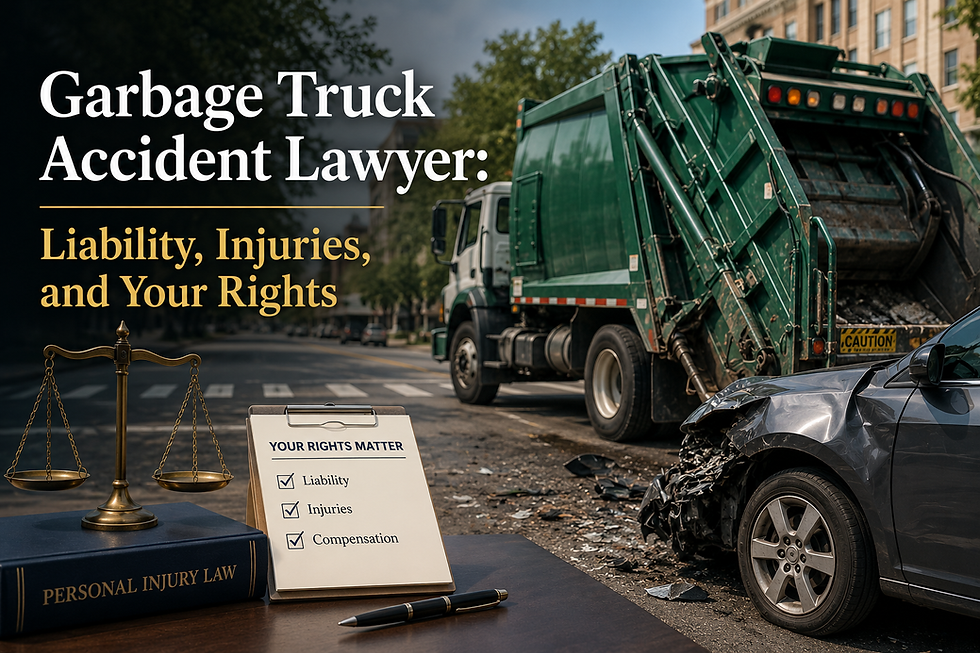
Garbage Truck Accident Lawyer: Liability, Injuries, and Your Rights
Last Reviewed: May 26, 2026
Publisher: PI Law News
Author: Peter Geisheker
This article is for informational purposes only and does not constitute legal or medical advice. If you have been injured in a truck accident, consult a licensed attorney in your state and seek care from a qualified medical provider.
A garbage truck accident lawyer represents people injured by a sanitation or refuse truck and determines whether a city, a private hauler, the driver, or a maintenance or equipment company is liable. Refuse collection is one of the deadliest occupations in the country, these heavy, frequent-stopping trucks cause severe pedestrian, cyclist, and vehicle injuries, and whether the truck is public or private decides how quickly you must act.
Key Facts at a Glance
Refuse and recyclable material collection had a fatality rate of 41.4 per 100,000 workers in 2023 — the fourth-deadliest U.S. occupation (BLS Census of Fatal Occupational Injuries).
Transportation incidents were the leading cause of those refuse-collection deaths (SWANA, reporting BLS data).
A fully loaded garbage truck often exceeds 50,000 pounds — more than ten times the weight of a typical passenger car, which magnifies crash forces (IIHS).
Garbage trucks have large blind zones and make constant stops on residential streets, putting pedestrians and cyclists at high risk (IIHS large-truck research).
Whether the truck is municipal or privately operated decides your deadline: claims against a city face short government notice windows (see suing a government vehicle).
Commercial refuse trucks are subject to federal safety rules on maintenance and driver qualification (49 CFR Parts 390–397).
If a garbage or sanitation truck injured you, the party at fault may be a city with a deadline as short as 90 days. Get a free case evaluation to protect your claim now.
Garbage trucks are among the largest and most dangerous vehicles operating on ordinary residential streets. They weigh tens of thousands of pounds, stop every few houses, reverse constantly, and carry workers who ride and walk around the truck in traffic. When one of these vehicles strikes a pedestrian, cyclist, or passenger car, the injuries are frequently catastrophic.
The danger is not anecdotal. In 2023, refuse and recyclable material collection ranked as the fourth-deadliest occupation in the United States, with a fatality rate of 41.4 per 100,000 workers, and transportation incidents were the leading cause of those deaths (BLS). The same forces that endanger sanitation workers endanger everyone sharing the road with the truck.
A garbage truck case also carries a complication most crashes do not: the truck may be operated by a city, a county, or a private hauling company, and that single fact controls who you sue and how little time you have to do it. This guide explains why these crashes happen, who can be held liable, how the public-versus-private question reshapes your claim, what injuries and compensation are involved, and why specialized legal help matters.
In this article
What a garbage truck accident lawyer does
Why garbage truck accidents are so dangerous
What causes garbage truck accidents
Who can be held liable in a garbage truck accident
Whether the truck is public or private — and why it changes your claim
What injuries are common in garbage truck accidents
What compensation you can recover
What to do after a garbage truck accident
Why hiring a specialized lawyer matters
Frequently asked questions
What Does a Garbage Truck Accident Lawyer Do?
A garbage truck accident lawyer investigates the crash, identifies every liable party, preserves time-sensitive evidence, and pursues compensation through an insurance claim or lawsuit. The work starts with one threshold question: who operated the truck?
Because a sanitation route can be run by a municipality or by a private contractor, the lawyer's first task is to determine ownership and operation, which dictates the legal path and the deadline. From there, counsel secures the truck's maintenance and inspection records, the driver's qualification file, any onboard camera or telematics data, the route and collection logs, and the police report — records that can be lawfully discarded on a routine schedule if no one demands their preservation.
The attorney then builds the damages case with medical and financial documentation and identifies all sources of recovery. Determining who is liable in a truck accident is rarely simple when a public entity, a private hauler, and a maintenance vendor may each share fault.
Just as important, the lawyer manages the deadlines and the defense. If a city operated the truck, counsel calendars and files the government notice of claim long before the short window closes; if a private hauler did, counsel deals with a commercial insurer that is working to minimize the payout from the first phone call. In both situations, the injured person is far better served having an advocate handle the procedure while they focus on recovering.
Why Are Garbage Truck Accidents So Dangerous?
Garbage trucks combine extreme weight, poor visibility, and a stop-and-go duty cycle in exactly the places where people walk and bike. That combination is what makes these crashes so severe.
A fully loaded refuse truck often exceeds 50,000 pounds, more than ten times a typical car, so the energy delivered in any impact is enormous (IIHS). The trucks also have large blind zones to the front, sides, and especially the rear, and they reverse far more often than other large vehicles. Add frequent stops, workers moving around the vehicle, and routes that run through dense residential neighborhoods, and pedestrians and cyclists are exposed to repeated risk.
The occupational data reflects the same hazard from the worker's side: with a 2023 fatality rate of 41.4 per 100,000 and transportation incidents as the leading cause, refuse collection sits among the most dangerous jobs in the country. The danger that kills sanitation workers — backing, blind spots, and being struck — is the same danger that injures the public.
What Makes Garbage Truck Cases Different From Other Truck Accidents?
A garbage truck case is not just a heavy-truck case. Several features set it apart and shape how the claim must be handled from day one.
First, the operator is often a government body, which injects sovereign immunity, a notice-of-claim requirement, and a deadline measured in months rather than years. Second, the crashes overwhelmingly happen in dense residential and urban settings, so the victims are frequently pedestrians and cyclists rather than other motorists, and the injuries are correspondingly severe. Third, the truck has workers moving on and around it during collection, which creates liability scenarios — a worker directing traffic, spotting a reverse, or riding the rear step — that simply do not exist in a highway tractor-trailer crash. Fourth, the most useful evidence is held by the operator: onboard cameras, telematics, route logs, and maintenance files that can be overwritten or discarded on a routine schedule unless preserved. Each of these features changes the strategy, and missing any one of them can sink an otherwise strong claim.
What Causes Garbage Truck Accidents?
Most garbage truck crashes trace to a small set of recurring causes, and identifying the precise one is how a lawyer establishes liability.
Backing and reversing collisions
Garbage trucks reverse far more than ordinary trucks, and backover crashes are a leading cause of injury to pedestrians, workers, and vehicles behind the truck. Inadequate spotters, broken backup alarms, or a failed camera often contribute. Safe operation generally calls for a working backup alarm, a rear camera, and a spotter for blind maneuvers; when one of those is missing or ignored, a reversing collision becomes both foreseeable and provable.
Blind-spot and no-zone strikes
The truck's large blind zones mean a driver may never see a cyclist or pedestrian alongside or behind the vehicle. These no-zones extend across the front, both sides, and especially the rear of a refuse truck, and a person standing in one is effectively invisible to the driver. Proving the crash occurred in a known blind spot is central to these cases; see our analysis of no-zone blind-spot trucking collisions.
Wide turns and sudden stops
Refuse trucks swing wide to turn and stop abruptly at each collection point, catching following or adjacent drivers off guard. A stop without adequate signaling or hazard lights can shift fault squarely onto the operator.
Route pressure, fatigue, and mechanical failure
Tight route quotas push drivers to move quickly, and fatigue, distraction, and skipped maintenance follow. Brake, hydraulic, and tire failures on a heavy truck can be catastrophic and often trace to violations of federal maintenance rules (49 CFR Part 396).
Where and When Do Garbage Truck Accidents Happen?
Garbage truck crashes cluster in predictable places and times, and that pattern helps explain why pedestrians and cyclists are so often the victims.
Most collection happens on residential streets, in alleys, and at intersections where the truck must stop, reverse, and swing wide repeatedly. Routes frequently run in the early morning, when light is poor and the truck shares quiet streets with commuters, joggers, children heading to school, and cyclists. The truck's constant stopping creates a false sense of safety for people who walk around or behind it, exactly when the driver's blind zones are largest. Add narrow streets lined with parked cars that hide approaching pedestrians, and the early-morning residential route becomes the single most dangerous setting for these crashes, hour for hour and mile for mile.
Who Can Be Held Liable in a Garbage Truck Accident?
Liability often extends well beyond the driver. Part of the lawyer's job is to identify every responsible party, because each may carry separate insurance or, in the case of a city, separate procedural rules.
Potentially liable party | Basis of liability | Key evidence / source |
Garbage truck driver | Negligent operation: unsafe backing, blind-spot strike, sudden stop | Police report, camera and telematics data, route logs |
Hauling company (private) | Respondeat superior; negligent hiring, training, or supervision | Driver qualification file (49 CFR Part 391) |
Municipality / public entity | Liability for a city-operated truck, subject to tort-claims rules | Government claim filing (suing a government vehicle) |
Maintenance provider | Negligent repair or inspection causing mechanical failure | Inspection and maintenance records (49 CFR Part 396) |
Truck or equipment manufacturer | Defective brakes, hydraulics, alarms, or camera (product liability) | Component inspection, recall data, expert analysis |
Other motorists | A third driver's actions contributed to the collision | Witness statements, reconstruction, scene evidence |
Is the Garbage Truck Public or Private — and Why Does It Change Your Claim?
This is the most important early question in a garbage truck case. Many cities run their own sanitation fleets, while others contract collection to private companies such as the national haulers. The answer decides both who you sue and how quickly you must act.
If a city or other public entity operated the truck, your claim runs through that government's tort claims act, which usually requires a written notice of claim within a short, strict deadline — often six months, and as little as 90 days in some states — long before the ordinary injury deadline. Missing it can bar the claim entirely. The full rules are in our guide to suing a government vehicle.
If a private hauling company operated the truck, the claim proceeds under ordinary negligence and commercial-insurance rules, with the standard injury statute of limitations. Private carriers typically carry substantial coverage, but they also field experienced defense teams, so preserving evidence early is just as important.
Telling the two apart is not always obvious from the side of the road. The truck's markings, the unit number, and the body design offer clues, but the definitive answer comes from public contracting records and the crash report. Some routes are run directly by a city department; others are outsourced to a national or regional hauler under a municipal contract, and in a few arrangements both a public entity and a private company can share responsibility. Resolving this quickly is essential, because it sets the deadline clock and names the defendant.
How Is Fault Proven in a Garbage Truck Accident?
Fault in a garbage truck case is built from the truck's own records and the physical evidence at the scene — not from the driver's account alone. Securing that evidence before it disappears is the heart of the case.
Modern refuse trucks carry cameras and telematics that capture speed, braking, reversing, and the moments around a collision; route and collection logs show where the truck was and how it was being operated. Maintenance and inspection records reveal whether brakes, hydraulics, backup alarms, or cameras had known defects, and federal rules require carriers to keep them (49 CFR Part 396). The driver's qualification file shows whether the operator was properly licensed, trained, and screened (49 CFR Part 391). For backing and blind-spot crashes, fault often turns on whether a spotter was used and whether the backup alarm worked. An accident reconstruction expert ties the data, the damage, and the scene together. Because much of this evidence sits in the operator's control and can be lawfully discarded on a schedule, a written preservation demand should go out immediately — a step that often decides whether the proof still exists when the case is built.
What Injuries Are Common in Garbage Truck Accidents?
Because of the truck's weight and the vulnerability of the people it strikes — often pedestrians and cyclists with no protection — garbage truck injuries tend to be severe and life-altering.
Injuries frequently seen in garbage truck cases include:
Traumatic brain injury from head impact or being struck while on foot
Spinal cord injury, including partial or complete paralysis
Crush injuries and amputations, especially in backover and side-impact crashes
Multiple fractures requiring surgery
Internal organ damage and internal bleeding
Severe lacerations and degloving injuries
Wrongful death, given the frequency of fatal pedestrian and cyclist strikes
Many of these injuries require surgery, long rehabilitation, and lifelong care, and their true cost is not apparent in the first weeks. Valuing future medical needs correctly is one of the most important parts of the claim.
Some of the most serious injuries are not obvious at the scene. Traumatic brain injuries and internal bleeding can present hours or days later, which is why prompt medical evaluation matters both for health and for the claim: a documented medical record created soon after the crash links the injury to the collision and prevents the operator's insurer from arguing the harm came from something else.
The same hazards that make refuse collection the fourth-deadliest job in America — backing, blind zones, and being struck — are exactly the hazards that injure pedestrians and cyclists sharing the street.
What Compensation Can You Recover After a Garbage Truck Accident?
You can generally recover both economic and non-economic damages, though the available amount depends heavily on whether the defendant is a private hauler or a government entity.
Economic damages cover medical bills, future care, lost income, lost earning capacity, and property damage. Non-economic damages cover pain and suffering, disfigurement, and loss of enjoyment of life. In a fatal case, surviving family members may pursue a wrongful death claim for funeral costs, lost support, and loss of companionship.
Against a private hauler, recovery follows ordinary tort rules and the carrier's insurance limits. Against a city, statutory damage caps and the bar on punitive damages may apply — another reason the public-versus-private question matters so much. Speak with a personal injury attorney before accepting any settlement figure.
Valuing the claim correctly means looking past the first medical bill. Severe garbage truck injuries — brain trauma, spinal damage, crush injuries, amputations — often require years of treatment, surgeries, assistive devices, home modifications, and lost future earnings. A serious case typically relies on medical and economic experts to project lifetime cost, because an early settlement based only on bills already received almost always undervalues what the injury will actually cost the victim over time.
What Should You Do After a Garbage Truck Accident?
The steps you take in the first days protect both your health and your right to compensation — and if a city operated the truck, the deadline clock is already running. Treat the aftermath as time-sensitive even if your injuries feel manageable, because both the medical record and the evidence trail are strongest when they are created right away.
Call 911 and get immediate medical care, even if injuries seem minor.
Photograph the truck — company or city name, unit number, and license plate — plus the scene, vehicles, and your injuries.
Identify whether the truck is municipal or a private hauler, and collect witness names and contact information.
Preserve evidence and do not give a recorded statement to the operator's insurer or risk department before getting advice.
Contact a lawyer immediately so any government notice of claim is filed well within the shortened deadline.
For the full post-crash checklist, see our guide on what to do after a truck accident.
Why Does Hiring a Lawyer Who Handles Garbage Truck Cases Matter?
Garbage truck cases blend heavy-vehicle litigation with a public-entity wrinkle that traps unrepresented claimants. The right lawyer handles both.
An experienced attorney quickly determines whether the truck was public or private, files any government notice of claim on time, sends a preservation demand for the truck's data and maintenance records before they are overwritten, and identifies every liable party — driver, hauler, municipality, maintenance vendor, or manufacturer. The same urgency applies to other street-level service vehicles, such as tow trucks, and to commercial truck claims generally.
Most garbage truck accident lawyers work on contingency, charging no upfront fee and taking a percentage of any recovery, so cost is not a barrier to getting help. Given how fast evidence disappears and how short a government deadline can be, the single most valuable thing a lawyer does is act immediately to keep the claim alive. The first days after the crash, when the footage still exists and the notice window is still open, are when the case is most often won or lost.
Frequently Asked Questions
How much does it cost to hire a garbage truck accident lawyer?
Most garbage truck accident lawyers work on contingency, charging no upfront or hourly fees and instead taking a percentage of your recovery, commonly 30% to 40%. If you do not win, you typically owe no attorney fee. Clarify how case expenses are handled before you sign.
Who is liable if a city garbage truck hit me?
If a municipality operated the truck, the city itself is typically the defendant, under the rule that an employer answers for an employee's negligence on the job. But suing a city means following its tort claims act and a short notice deadline; see our guide to suing a government vehicle.
How long do I have to file a claim after a garbage truck accident?
It depends on who operated the truck. Against a private hauler, the ordinary injury statute of limitations applies. Against a city, you may have only months — sometimes 90 days — to file a written notice of claim. Because the government deadline is so short, contact a lawyer immediately.
What if the garbage truck was operated by a private company?
Then your claim proceeds under ordinary negligence and the company's commercial insurance, with the standard statute of limitations. Private national haulers carry substantial coverage, but they also use experienced defense teams, so preserving the truck's data and maintenance records early is critical.
Are garbage truck accidents really that common or dangerous?
Yes. Refuse and recyclable material collection was the fourth-deadliest U.S. occupation in 2023, with a fatality rate of 41.4 per 100,000 workers, and transportation incidents were the leading cause (BLS). The hazards that endanger workers also injure pedestrians, cyclists, and other drivers.
What evidence is most important in a garbage truck accident case?
The police report, scene and damage photos, the truck's onboard camera and telematics data, route and collection logs, the driver's qualification file, and maintenance and inspection records. Much of this is in the operator's control and can be lost quickly, so a preservation demand should go out fast.
Can I sue if a garbage truck backed into me or my vehicle?
Yes. Backover and reversing collisions are a leading cause of garbage truck injuries. Liability often turns on whether the driver used a spotter, whether the backup alarm and camera worked, and whether the maneuver was safe. These are exactly the facts an investigation establishes.
What if a sanitation worker, not just the truck, caused the crash?
The employer — the city or the private hauler — is generally responsible for a worker's negligence committed on the job, whether that worker was driving, spotting, or loading. Identifying the correct employer is part of determining the right defendant and deadline.
Can I recover compensation if I was partially at fault?
Usually yes, depending on your state's rule. Most states follow comparative negligence, which reduces your recovery by your share of fault rather than barring it. Your attorney will explain how your state's law applies to your circumstances.
How do I find a lawyer for a garbage truck accident near me?
Look for a firm that handles commercial-truck and public-entity cases, not a general practice, and use the free consultation to compare experience. You can also contact us for free help finding a garbage truck accident lawyer in your area.
Can I sue if a garbage truck hit a pedestrian or cyclist?
Yes. Pedestrians and cyclists are among the most common and most seriously injured victims in garbage truck crashes, because the trucks operate at walking pace through neighborhoods with large blind zones and frequent reversing. An injured pedestrian or cyclist — or the family of one who was killed — can pursue a claim against the responsible driver and operator.
What is a preservation letter and why does it matter in these cases?
A preservation (or spoliation) letter is a formal written demand that the truck operator preserve specific evidence — camera footage, telematics, route logs, and maintenance records — instead of overwriting or discarding it on a routine schedule. Because that evidence is in the operator's control and can be lost within weeks, sending the letter quickly is one of the most important early steps a lawyer takes.
References and Sources
Census of Fatal Occupational Injuries. U.S. Bureau of Labor Statistics.
Large Truck and Bus Crash Facts. Federal Motor Carrier Safety Administration.
49 CFR Part 396 — Inspection, repair, and maintenance. eCFR.
Large Trucks research overview. Insurance Institute for Highway Safety.
Waste and recycling collection was fourth-deadliest occupation in 2023: BLS. Waste Dive.
Suing a Government Vehicle: Tort-Claims Deadlines and Sovereign Immunity. PI Law News.
Proving Liability in No-Zone Blind-Spot Trucking Collisions. PI Law News.
Editorial Standards and Review
This article was researched and written to PI Law News editorial standards. Occupational and crash statistics are cited to the U.S. Bureau of Labor Statistics and federal safety sources, and legal rules are cited to the Code of Federal Regulations and primary authority. Every external statistic in this guide links directly to its originating source so readers can verify it.
Under our zero-hallucination policy, every statistic links to its source, compensation is described in general terms rather than as a guarantee, and no claim is included that cannot be traced to a verifiable source. This content is educational only and is not legal or medical advice. Last reviewed May 26, 2026.
If a garbage or sanitation truck injured you or a loved one, the evidence that proves your case can disappear within weeks, and a government deadline may be even shorter. You can contact us for free to be connected with a garbage truck accident lawyer who will review your case at no cost and explain all of your options.


