How FMCSA Hours-of-Service Violations Can Triple Your Compensation in a Truck Accident Lawsuit
Updated: May 1
Last Reviewed: April 13, 2026
Publisher: PI Law News
Author: Peter Geisheker
This article is for informational purposes only and does not constitute legal advice. No attorney-client relationship is created by reading this content. If you were injured in a truck accident, you should consult a qualified personal injury attorney licensed in your state.
Every year, thousands of families are devastated by collisions with commercial trucks — crashes that leave victims with catastrophic injuries, mountains of medical debt, and no clear answers about why it happened. But buried inside the federal regulatory system is a powerful legal tool that most victims never know exists until they hire the right truck accident attorney: FMCSA hours-of-service violations.
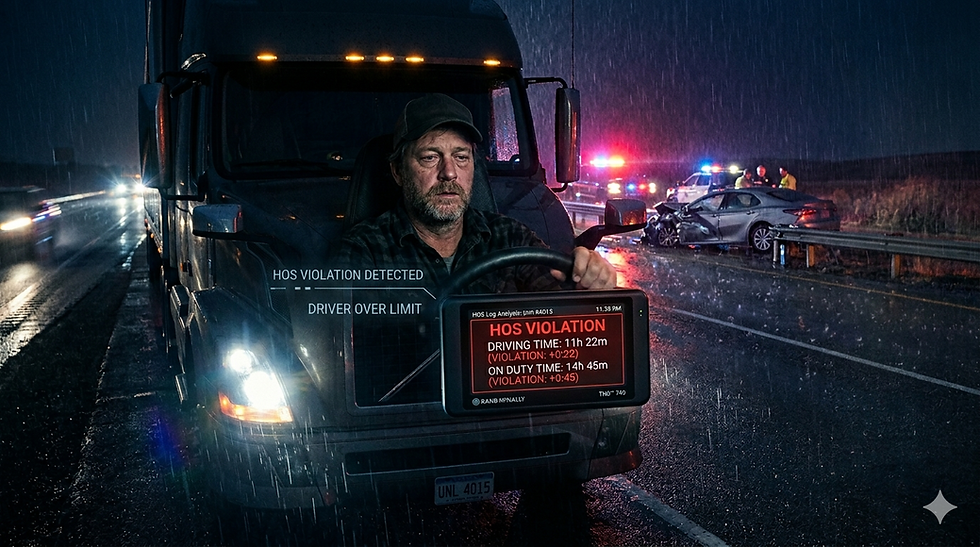
When a commercial truck driver or trucking company violates the Federal Motor Carrier Safety Administration’s hours-of-service (HOS) regulations — the federal rules that govern how long drivers can operate before resting — those violations can do far more than prove the driver was tired. They can transform a standard personal injury claim into a high-value lawsuit that pursues not just compensatory damages for your medical bills and lost wages, but punitive damages designed to punish reckless corporate behavior.

In 2023, 5,472 people were killed in traffic crashes involving large trucks, and the majority of those fatalities were not the truck driver — they were occupants of other vehicles, pedestrians, and cyclists. (Source: NHTSA/FreightWaves, 2024) According to the FMCSA’s Large Truck Crash Causation Study, driver action or inaction was the critical reason in 88 percent of crashes involving large trucks. (Source: FMCSA Large Truck Crash Causation Study) Fatigue is among the most studied and preventable of those driver factors, and hours-of-service violations are the documentary paper trail that proves it happened.
This article explains exactly how FMCSA HOS regulations work, what violations look like in the real world, how a skilled commercial truck accident attorney uses those violations to build a negligence case, and — critically — why documented HOS violations can multiply your total compensation far beyond what a standard traffic accident would ever produce.
If you or someone you love was injured in a crash with a commercial truck and you suspect the driver may have been fatigued or violating federal driving limits, get a free case evaluation today.
Key Takeaways
FMCSA Hours-of-Service regulations are codified at 49 CFR Part 395 and are legally binding on all commercial motor vehicle operators
Violations of HOS rules constitute negligence per se in most jurisdictions — meaning fault is automatic once the violation is proven
HOS violations can unlock punitive damages, which are awarded on top of compensatory damages and can dramatically increase total compensation
Electronic Logging Devices (ELDs) create an objective, tamper-resistant record of every hour a driver spends behind the wheel
Trucking companies that pressure drivers to exceed HOS limits face direct corporate liability — not just liability for the driver’s conduct
ELD records, logbooks, fuel receipts, and dispatch communications are critical evidence — and federal law only requires trucking companies to keep them for as little as six months
Acting quickly after a crash is essential: evidence can disappear, be altered, or be legally destroyed after retention windows expire
A truck accident lawyer experienced in FMCSA litigation can send a spoliation letter to preserve evidence before it vanishes
Quick Answer
FMCSA hours-of-service violations occur when a commercial truck driver exceeds federally mandated driving or on-duty limits under 49 CFR Part 395. In truck accident lawsuits, these violations establish negligence per se — automatic proof of a breach of duty — and can support claims for punitive damages when a carrier knowingly permitted or encouraged the violations, significantly increasing total compensation for injured victims.
Table of Contents
What Are FMCSA Hours-of-Service Regulations?
The Federal Motor Carrier Safety Administration was created by Congress to reduce crashes, injuries, and fatalities involving large commercial motor vehicles. To accomplish that mission, the FMCSA promulgates and enforces a comprehensive body of federal safety regulations — and among the most consequential are the hours-of-service rules codified at 49 CFR Part 395.
The hours-of-service regulations define the maximum amount of time drivers are permitted to be on duty or driving. These rules apply to any commercial motor vehicle used in interstate commerce weighing more than 10,001 pounds, as well as vehicles transporting hazardous materials or carrying more than a specified number of passengers. If a truck operates across state lines — or hauls goods that will eventually cross state lines — the FMCSA’s HOS rules almost certainly apply. (Source: Killino Firm, 49 CFR Part 395)
The logic behind these regulations is grounded in science. Fatigue dramatically impairs the cognitive and physical performance of commercial drivers. When a commercial truck driver is exhausted after driving too many hours without adequate rest, their reaction time slows, their judgment becomes impaired, and they become significantly more likely to fall asleep at the wheel — and even a few seconds of drowsing can cause devastating crashes. (Source: MartinWren Law)
Fatigue remains one of the leading causes of large truck crashes in the United States, which is why the FMCSA continuously enforces strict HOS limits. Even a single HOS violation can lead to increased CSA scores, Out-of-Service orders, and penalties during roadside inspections or compliance audits. (Source: Safe Road Compliance, 49 CFR Part 395 Guide)
When these regulations are violated — and the violation contributes to a crash — the legal consequences for the driver and the trucking company can be severe.
The Five Core HOS Rules Every Victim Should Know
Understanding the specific rules that were violated in your crash is essential to building a strong legal case. The HOS rules for property-carrying truck drivers limit daily driving time to 11 hours and daily work days to 14 hours, after 10 consecutive hours off duty. The regulations also limit maximum work weeks to 60 hours for 7 consecutive days and 70 hours for 8 consecutive days. (Source: Killino Firm, HOS Regulations)
The 11-Hour Driving Limit
A property-carrying driver may not drive more than 11 hours following 10 consecutive hours off duty. Exceeding the 11-hour driving limit under 49 CFR §395.3(a)(3) is one of the most frequently cited HOS violations, because driving beyond 11 hours significantly increases fatigue-related crash risk. (Source: Safe Road Compliance, HOS Violations Guide) This is the rule most commonly associated with driver fatigue lawsuits.
The 14-Hour On-Duty Window
Even if a driver has not yet accumulated 11 hours of actual driving time, they cannot continue driving once 14 consecutive hours have elapsed since they came on duty — regardless of how many breaks they took. This rolling window rule is among the most widely misunderstood — and most frequently violated.
The 30-Minute Break Rule
Property-carrying drivers must take a 30-minute break during the first 8 hours of any shift. Specifically, they may drive only if 8 hours or less have passed since the end of their last off-duty or sleeper-berth rest period of at least 30 minutes, per 49 CFR §395.3. (Source: Killino Firm, 49 CFR §395.3)
The 10-Hour Off-Duty Requirement
Before a driver can resume driving, they must have taken at least 10 consecutive hours off duty. Trucking companies that pressure drivers to shorten their mandatory rest periods in order to make delivery deadlines are directly violating federal law.
The 60/70-Hour Weekly Maximum
Drivers can only be on duty for a maximum of 60 hours in a seven-day period or 70 hours in an eight-day period. Violations of this cumulative limit are particularly dangerous because they reflect long-term, chronic fatigue rather than a single shift that ran too long.
How HOS Violations Establish Negligence Per Se
For victims injured in a truck accident, the difference between proving ordinary negligence and proving negligence per se can mean the difference between a modest settlement and a multi-million-dollar verdict.
In standard negligence cases, you must prove: (1) the defendant had a duty of care; (2) they breached that duty; (3) the breach caused your injuries; and (4) you suffered damages. Establishing each element requires evidence, expert testimony, and argument. Defense attorneys will dispute every point.
Negligence per se is fundamentally different. When a defendant violates a statute or safety regulation that was specifically designed to protect the class of people harmed — and the violation caused the injury — courts often instruct juries that the breach of duty element is automatically established. The violation of the regulation is the breach.
Federal trucking violations create powerful legal advantages because they establish negligence per se — automatic proof that the carrier breached its duty. (Source: TruckingAccident.com, DOT Violations Guide) This is not a theory — it is a well-established doctrine applied in truck accident cases across the country.
In truck accident cases, HOS violations strengthen the case more than in a typical car accident claim. Instead of arguing over simple mistakes, the focus shifts to whether a professional driver followed clear safety rules. When a driver breaks these rules, it shows a failure to meet required safety standards. Insurance companies know that juries react strongly to evidence of fatigued driving and safety rule violations, and clear evidence of violations can lead to faster and larger truck accident settlements.
A truck accident lawyer experienced in federal trucking law will identify every applicable HOS regulation and build a timeline that shows precisely when, where, and how the driver exceeded those limits — and how that fatigue caused the crash.
The Role of Electronic Logging Devices as Evidence
Prior to 2017, truck drivers were required to keep paper logbooks documenting their hours — a system that was notoriously easy to falsify and manipulate. Congress and the FMCSA responded by mandating Electronic Logging Devices for most interstate commercial carriers, and the result transformed the evidentiary landscape for truck accident victims.
Electronic Logging Devices automatically record a driver’s record of duty status, including driving time, on-duty not driving periods, and off-duty rest. Unlike paper logbooks, electronic logs sync with the vehicle’s engine data, making it significantly harder to conceal excessive duty hours. (Source: Justin for Justice Law, HOS Rules)
Under 49 CFR §395.26, ELDs must automatically capture date, time, geographic location, engine hours, vehicle movement, and other data points. This electronic evidence often reveals sudden deceleration patterns or excessive speeds that driver testimony might dispute, providing objective timelines that anchor catastrophic injury claims. (Source: Equal Voice for Families, Commercial Truck Accident Settlements)
This matters enormously in litigation. When an ELD record shows a driver had been behind the wheel for 14 hours before a crash, that data is objective and difficult to refute. Defense attorneys cannot call it a memory error, a misunderstanding, or a bookkeeping mistake. The engine was running. The wheels were turning. The record does not lie.
However, ELD data is not infallible. Some drivers or motor carriers may falsify logbook entries, misclassify on-duty time, or claim an ELD malfunction after a crash. Discrepancies between electronic logs and supporting documents — such as fuel receipts, inspection reports, and shipping records — can reveal these attempts to conceal violations.
Evidence Preservation Alert: Federal law under 49 CFR §395.8 requires carriers to maintain Records of Duty Status — including ELD data — for only six months. Once that window closes, a trucking company may legally destroy the records. You must act immediately after a truck crash to preserve this evidence through formal legal channels.
How Trucking Companies Become Directly Liable
One of the most financially significant aspects of HOS violation cases is that they often expose the trucking company — not just the individual driver — to direct liability. This matters because commercial trucking companies typically carry far larger insurance policies than individual drivers, and they may also be subject to punitive damages in their own right.
When a company ignores clear violations, pushes drivers to work longer, or fails to monitor ELD records, it may be liable for the resulting truck accident. Company pressure, poor supervision, and log manipulation all strengthen a negligence claim.
A carrier is liable both for the actions of its drivers in submitting false documents and for its own actions in accepting false documents, according to federal regulatory guidance interpreting 49 CFR §395.8. Motor carriers have a legal duty to require drivers to observe the Federal Motor Carrier Safety Regulations. (Source: Atlanta Injury Lawyer, FMCSR Civil Enforcement)
This means that if dispatch records, internal communications, or load scheduling data show that the company was aware — or should have been aware — that its drivers were operating in violation of HOS rules, the company faces direct exposure. Internal communications showing management's knowledge of violations become smoking gun evidence. DOT whistleblower protections encourage these disclosures, which frequently reveal systemic safety failures that public records never capture.
A truck accident attorney with experience in FMCSA litigation knows how to subpoena these records before they disappear and how to use them to maximum effect at trial or in settlement negotiations.
Speak with a personal injury attorney to find out how corporate liability might apply in your case.
Logbook Falsification: When Violations Become Criminal
When truck drivers or trucking companies falsify HOS records — whether in paper logbooks or by manipulating ELD data — the legal exposure escalates dramatically. Falsification transforms a regulatory violation into evidence of deliberate fraud, and in personal injury cases, deliberate fraud is among the strongest grounds for punitive damages.
False log violations are among the most serious hours-of-service violations in the entire FMCSA rulebook. Under 49 CFR §395.8(e), a driver’s record of duty status must be accurate, truthful, and reflect actual time spent driving. Any intentional discrepancies can lead to a false log citation, which significantly increases a carrier’s HOS BASIC score. The FMCSA considers false logs a red flag because they indicate deliberate non-compliance and potential fatigue-related risk. During audits, investigators compare ELD logs to fuel receipts, weigh station records, dashcam timestamps, and GPS data. Any mismatch can trigger a violation.
The Cover-Up Is Often Worse Than the Crime: In truck accident litigation, attorneys have consistently found that the falsification of HOS records — not just the underlying violation — is what drives juries to award the largest verdicts. When a jury sees that a trucking company falsified federal safety records after killing or seriously injuring someone, their response is predictable and powerful.
What Damages Can You Recover?
When FMCSA hours-of-service violations are proven in a truck accident lawsuit, the categories of recoverable damages expand significantly beyond what a standard car accident claim would produce. There are two primary categories: compensatory damages and punitive damages.
Compensatory Damages
Compensatory damages are intended to make the victim financially whole by covering actual losses. In serious truck accident cases, these typically include:
All past and future medical expenses, including emergency care, surgery, hospitalization, rehabilitation, home health care, and prescription medications
Lost wages from the time of injury through the date of trial, including lost earning capacity if injuries prevent return to prior occupation
Pain and suffering — both physical pain and the emotional and psychological toll of living with serious injuries
Loss of consortium and loss of companionship, which compensate family members for the loss of their relationship with the victim
Property damage, including the total loss or repair cost of your vehicle and any other property destroyed in the crash
Future medical costs, calculated with expert testimony from life care planners and medical economists
Statistics: According to the NHTSA Fatality Analysis Reporting System, 5,472 people were killed in large truck crashes in 2023, with over 70% of those fatalities being people outside the truck. (Source: NHTSA/FreightWaves, 2024)
How HOS Violations Unlock Punitive Damages
Punitive damages are the financial multiplier that gives this article its headline. Unlike compensatory damages, punitive damages are not designed to reimburse the victim — they are designed to punish the defendant and deter future misconduct. Courts award them when the defendant’s behavior was especially reckless, willful, or wanton.
In truck accident cases, FMCSA hours-of-service violations — particularly when combined with evidence that the trucking company knew about, encouraged, or ignored those violations — create the conditions for punitive damage awards.
Evidence that a company encouraged or ignored HOS violations can support punitive damage claims in addition to compensatory damages. It demonstrates industry knowledge: trucking companies know about HOS regulations and the dangers of driver fatigue, so violations show they chose to prioritize profits over safety.
The mechanism works as follows. Punitive damages require proof of a culpable mental state beyond simple negligence — typically recklessness, willful misconduct, or conscious disregard for the safety of others. When a trucking company scheduled routes that could not be completed without violating HOS rules, failed to monitor ELD records despite a legal obligation to do so, pressured drivers to make deliveries regardless of hours-of-service limits, accepted false logbooks without investigation, or had a history of prior HOS violations — that company has demonstrated conscious disregard for public safety in a manner that supports punitive damages.
When HOS violations are proven, it can lead to a more favorable settlement or court judgment. The violation demonstrates a clear breach of duty, which can result in punitive damages in addition to compensatory damages. Punitive damages are intended to punish the defendant for their reckless behavior and deter others from engaging in similar conduct.
A Note on “Nuclear Verdicts”: The trucking industry uses the term “nuclear verdict” to describe jury awards in the tens or hundreds of millions of dollars. These verdicts are disproportionately common in cases involving documented federal safety violations and corporate cover-ups. FMCSA HOS violations, particularly when combined with logbook falsification and dispatch pressure, are among the most frequent triggers.
Contact us for a free consultation to discuss whether HOS violations and punitive damages may apply to your case.
The Evidence You Need — and Why Time Is Critical
No matter how strong the legal theory, a truck accident case lives or dies on the quality of its evidence. FMCSA HOS violation cases require a specific body of documentation — and much of it exists on a ticking legal clock.
Electronic Logging Device (ELD) Data
This is the primary source of proof. Motor carriers must preserve Records of Duty Status, including ELD data, for only six months under 49 CFR §395.8(k). Given these ticking federal clocks, immediate preservation action determines whether your attorney can prove regulatory violations that establish liability. (Source: Equal Voice for Families, Commercial Truck Accident Settlements)
Driver Qualification Files
These records contain the driver’s commercial license history, medical certifications, employment history, prior violations, and training records. They are required to be maintained for three years after employment ends under 49 CFR §391.51. Prior HOS violations in the driver’s history are powerful evidence of a pattern of unsafe behavior.
Dispatch Communications
Text messages, emails, calls, and software-generated route assignments can reveal whether the company was directing the driver to make deliveries on schedules that required violating HOS rules. These communications are often the most powerful corporate liability evidence in the case.
The Spoliation Letter
This is a formal legal demand sent to the trucking company, their insurer, and their legal counsel, requiring them to immediately preserve all potentially relevant evidence. An attorney should send this letter within days of the crash. Trucking companies are only required to maintain certain records for limited periods, and some evidence may be destroyed or altered if not preserved promptly. (Source: Paynter Law, HOS Violations and Truck Accidents)
Acting quickly is not just advisable — it is legally critical. The first 72 hours after a serious truck accident are often determinative of whether the strongest evidence ever reaches a jury.
Get a free case evaluation and learn what evidence may still be available in your case.
FAQ: FMCSA HOS Violations and Your Truck Accident Claim
What exactly is an FMCSA hours-of-service violation?
An FMCSA hours-of-service violation occurs when a commercial truck driver or motor carrier fails to comply with the driving limits, rest requirements, or documentation rules established under 49 CFR Part 395. Common violations include exceeding the 11-hour daily driving limit, driving beyond the 14-hour on-duty window, failing to take a required 30-minute break within the first 8 hours of a shift, exceeding the 60/70-hour weekly on-duty maximum, and falsifying electronic or paper driver logs. Any one of these violations — when it contributes to a crash — can become the centerpiece of a personal injury lawsuit.
How do HOS violations prove the truck driver was negligent?
In most states, violating a federal safety regulation that was enacted to protect the public from exactly the type of harm that occurred constitutes negligence per se. This means the legal standard of care is defined by the federal regulation itself, and violating that regulation establishes the breach of duty element of negligence without additional proof. Your attorney still needs to prove causation — that the violation contributed to the crash and your injuries — but the violation itself removes the most hotly contested element of a typical negligence case. This is a significant legal advantage.
Can I sue the trucking company directly, even if the driver was an independent contractor?
Yes, potentially. Trucking companies can face direct liability on several independent theories: (1) vicarious liability if the driver was a company employee acting within the scope of employment; (2) direct negligence for failing to monitor compliance with federal regulations they are legally obligated to oversee; and (3) negligent entrustment for entrusting a vehicle to a driver they knew or should have known had a history of HOS violations. The independent contractor classification is frequently challenged in these cases, and courts look at the degree of control the carrier exercised over the driver’s schedule and routes.
Will HOS violations automatically increase my settlement value?
Not automatically — but they create conditions that predictably lead to higher settlements and verdicts. Insurance companies know that juries react strongly to evidence of fatigued driving and safety rule violations. Carriers and their insurers understand that HOS violation cases carry elevated trial risk — especially when there is evidence of corporate knowledge or cover-up — and they often settle for more rather than risk a punitive damages verdict. The key is working with an experienced attorney who knows how to develop and present the evidence.
What if the driver claims there was no fatigue, even though HOS rules were violated?
The driver’s subjective claim of alertness is largely irrelevant when objective HOS records show a violation. Courts and juries are well aware that fatigued drivers often do not recognize or admit their own impairment. Expert witnesses in fatigue science and accident reconstruction can testify about the established relationship between hours of driving and cognitive impairment. The fact that HOS rules exist — and were violated — is itself evidence that the driver was operating outside the federal safety envelope, regardless of their self-assessment.
How long do I have to file a truck accident lawsuit involving HOS violations?
Statutes of limitations for personal injury lawsuits vary significantly by state — typically ranging from one to three years from the date of the accident. However, the legal deadline is only one timing concern. Evidence preservation deadlines under federal law are far shorter: ELD records may be legally destroyed after six months, drug and alcohol test results have even tighter windows, and the physical evidence at the crash scene degrades quickly. You should contact a truck accident attorney as soon as possible after the crash — ideally within days — rather than waiting to assess your recovery.
What is a spoliation letter and why does it matter?
A spoliation letter is a formal written demand sent to the trucking company, its insurer, and its legal counsel, directing them to immediately preserve all documents and records potentially relevant to your claim. By sending this letter, your attorney creates a legal obligation to retain evidence that might otherwise be lawfully destroyed under routine records-retention schedules. If a carrier destroys evidence after receiving a spoliation letter, courts can impose severe sanctions — including instructing juries to infer that the destroyed evidence was unfavorable to the carrier. The spoliation letter is often one of the most powerful tools in a truck accident attorney’s early-case arsenal.
What types of crashes most commonly involve HOS violations?
Late-night and early-morning crashes are among the strongest indicators of potential HOS violations, as driver fatigue is most acute during these periods. Other red flags include: crashes where the truck showed no signs of braking or evasive action before impact; rear-end collisions at highway speed; lane departure crashes with no obvious environmental cause; and crashes occurring at the end of long-haul runs. Physical evidence of fatigue-related driving — such as a complete absence of skid marks or failure to respond to an obvious road hazard — combined with ELD data showing extended on-duty time creates a compelling evidentiary picture.
How much could punitive damages add to my total compensation?
There is no formula for punitive damages — they are determined by juries based on the egregiousness of the conduct, the financial condition of the defendant, and the need to deter future behavior. In cases where compensatory damages are substantial, and the carrier’s conduct was particularly reckless — for example, a company with a documented history of HOS violations that falsified logs and pressured drivers — punitive awards can equal or exceed the compensatory damages themselves. Discuss your case at no cost with an attorney who can assess the specific facts that would drive punitive exposure in your situation.
Authoritative References
FMCSA Hours-of-Service Regulations — 49 CFR Part 395, U.S. Department of Transportation
FMCSA Large Truck Crash Causation Study Analysis Brief, Federal Motor Carrier Safety Administration
5,472 People Died in Large Truck Crashes in 2023, FreightWaves Analysis
Civil Enforcement of Fatigue-Related Federal Motor Carrier Safety Regulations, Atlanta Injury Lawyer
Hours of Service Violations Guide — 49 CFR Part 395, Safe Road Compliance
Commercial Truck Accident Settlements and Federal Evidence, Equal Voice for Families
HOS Violations and Driver Fatigue in Truck Accidents, Martin Wren Law
FMCSA Hours-of-Service Rules and Driver Fatigue, Justin for Justice Law
How FMCSA Violations Strengthen Your Truck Crash Claim, J&Y Law
Editorial Standards & Review
PI Law News is committed to publishing accurate, well-researched legal information that serves injury victims and their families. This article was produced using verified sources, including FMCSA official regulations, NHTSA crash data, federal regulatory guidance, and established legal analysis from practicing attorneys.
All statistics cited in this article include inline source links at the point of reference. No case outcomes, settlement figures, or specific dollar amounts have been fabricated or presented without verified sourcing. All federal regulation citations reference actual codified regulations accessible through the eCFR. This article does not constitute legal advice and should not be relied upon as a substitute for consultation with a qualified attorney licensed in your state.
Last reviewed: April 2026 | If you identify any factual inaccuracy in this article, please contact us.