
The Role of Accident Reconstruction in Truck Accident Cases
Last Reviewed: June 22, 2026
Publisher: PI Law News
Author: Peter Geisheker
This article is for informational purposes only and does not constitute legal or medical advice. If you have been injured in a truck accident, consult a licensed attorney in your state and seek care from a qualified medical provider.
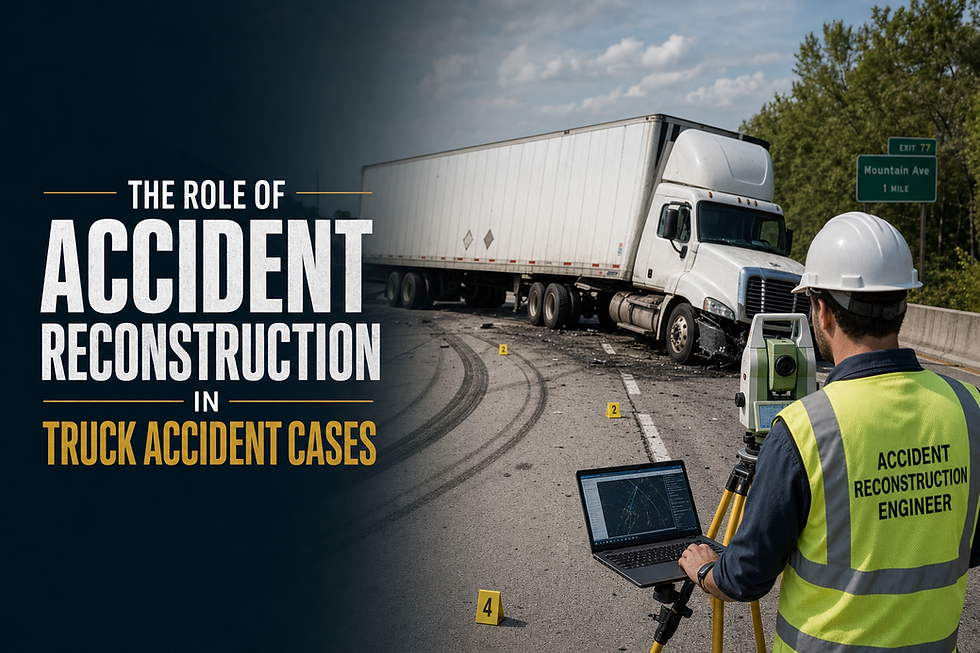
Truck accident reconstruction is the forensic process of using physics, the truck's electronic data, and physical scene evidence to determine how a crash happened, how fast each vehicle was traveling, and who caused it. In serious truck cases it is often the single most powerful tool for proving fault.
If you were seriously hurt in a truck crash, get a free case evaluation to find out whether an accident reconstruction can prove what really happened.
Key Facts at a Glance
The FMCSA Large Truck Crash Causation Study found that driver action or inaction was the critical reason in 87 percent of crashes involving large trucks — the exact failures a reconstruction is built to expose.
In 2023, 5,472 people died in large-truck crashes in the United States, and occupants of smaller vehicles bore the overwhelming majority of those deaths.
The federal Large Truck Crash Causation Study analyzed nearly 1,000 fatal and injury truck crashes using onsite investigations of the scene, the truck, and the driver.
FMCSA's Crash Causal Factors Program is now updating that 20-year-old study, after fatal large-truck and bus crashes rose 26 percent from 2016 to 2022.
A reconstruction expert's courtroom testimony must satisfy Federal Rule of Evidence 702, which since December 1, 2023 requires the court to confirm its reliability before a jury hears it.
The reliability standard for expert testimony traces to Daubert v. Merrell Dow Pharmaceuticals, which makes the judge a gatekeeper over scientific and technical opinions.
In this article:
What Is Accident Reconstruction in a Truck Accident Case?
Why Does Accident Reconstruction Matter More in Truck Cases Than Car Crashes?
What Does a Truck Accident Reconstruction Expert Actually Do?
What Evidence Does a Reconstructionist Rely On?
How Does the Truck's Black Box Feed the Reconstruction?
How Does Reconstruction Prove Speed and Who Caused the Crash?
How Does the FMCSA Crash-Causation Framework Guide a Reconstruction?
Why Must Evidence Be Preserved Before a Reconstruction Can Be Done?
Is a Reconstruction Expert's Testimony Admissible in Court?
How Does an Accident Reconstruction Increase Your Settlement Value?
When Should a Reconstruction Expert Be Hired After a Truck Accident?
What Should You Do to Protect a Future Reconstruction of Your Crash?
What Is Accident Reconstruction in a Truck Accident Case?
Accident reconstruction is the scientific process of rebuilding a collision after the fact to determine exactly how and why it happened. A reconstructionist — typically an engineer or a specially trained investigator — combines the laws of physics with the physical and electronic evidence left behind to calculate speeds, positions, timing, and the sequence of events. The result is an objective, evidence-based account of the crash that does not depend on whose memory is sharper.
In a truck case, that objectivity is decisive. Memories conflict, the truck driver and the carrier have every incentive to shape the story, and police reports are often incomplete. A reconstruction replaces that uncertainty with measurable facts. It is closely tied to how fault is proven in any truck accident case, and in the most serious crashes it is the backbone of the entire liability case.
It is worth being precise about what reconstruction is and is not. It is not guesswork or an educated opinion about what probably happened. It is applied physics: the same conservation laws, friction calculations, and energy principles taught in any engineering program, used in reverse to work backward from the evidence to the speeds and movements that produced it. Done well, a reconstruction is reproducible and testable, which is exactly what makes it persuasive to an insurer, a judge, and a jury.
Why Does Accident Reconstruction Matter More in Truck Cases Than Car Crashes?
Truck crashes demand reconstruction far more often than ordinary car accidents for three reasons: the physics, the stakes, and the evidence. A loaded tractor-trailer can weigh 80,000 pounds — roughly 20 to 30 times a passenger car — so the forces involved are enormous and the injuries catastrophic. When the harm is that severe, the parties fight hard over every detail of fault, and a precise, defensible reconstruction is what wins that fight.
Trucks also carry layers of data a car does not: an engine control module, an electronic logging device, telematics, and often dashcams. That richer evidence makes a rigorous reconstruction both possible and expected. And because federal data shows driver error is the critical reason in the large majority of truck crashes, the reconstruction's job is frequently to pinpoint which driver error — speeding, following too closely, or an unsafe maneuver — actually caused the collision.
There is also a strategic dimension. Trucking companies often send a rapid-response team — investigators and defense experts — to the scene within hours of a serious crash, building their own version of events before the victim has even left the hospital. A victim who does not commission an independent reconstruction is effectively letting the other side write the only technical account of the crash. Matching that effort, and doing it well, is how the playing field is leveled.
What Does a Truck Accident Reconstruction Expert Actually Do?
A reconstruction expert gathers every piece of physical and electronic evidence, then applies established engineering methods to convert that evidence into conclusions about speed, position, and timing. The work is methodical and, when done correctly, repeatable: another qualified expert applying the same methods to the same data should reach the same result. The table below summarizes the core techniques and what each one establishes.
Reconstruction Method | What It Determines | Primary Data Source |
Conservation of momentum | Pre-impact speed and direction of each vehicle | Rest positions, vehicle weights, crush |
Skid and yaw mark analysis | Vehicle speed before braking or in a turn | Tire marks and roadway drag factor |
Crush (damage) energy analysis | Closing speed and severity of impact | Measured vehicle deformation |
EDR / ECM data download | Speed, braking, throttle in seconds before impact | Truck black box / engine control module |
Scene mapping (total station / drone) | Geometry, sight lines, point of impact | Surveyed scene measurements |
Human factors analysis | Perception-reaction time and visibility | Lighting, sight distance, driver records |
No single method stands alone. The strongest reconstructions cross-check several techniques against one another — for example, confirming a momentum-based speed estimate against the truck's recorded black box speed — so the conclusion holds up when the defense's own expert attacks it.
The expert's process usually unfolds in stages. First comes evidence collection: inspecting and photographing both vehicles, downloading the electronic data under a documented protocol, and surveying the scene. Next is analysis, where the physical and electronic evidence is fed into the methods above and cross-checked. Finally comes the report and, if the case does not settle, testimony. Each stage is documented so that every conclusion can be traced back to a measurement, which is what gives the opinion its weight.
What Evidence Does a Reconstructionist Rely On?
A reconstruction is only as good as the evidence feeding it, and truck crashes leave an unusually rich trail. The reconstructionist typically works from a combination of the following:
The physical scene — skid and yaw marks, gouges, debris fields, fluid trails, and final rest positions, ideally surveyed before they are cleared.
Vehicle damage — the crush profile on both vehicles, which encodes the energy of the impact.
The truck's engine control module — recorded speed, brake application, throttle, and RPM in the seconds before impact.
The electronic logging device — hours-of-service data that can reveal fatigue as a contributing factor.
Photographs, dashcam, and surveillance video — visual confirmation of positions, signals, and driver behavior.
Roadway and environmental data — grade, sight distance, signal timing, lighting, and weather at the time of the crash.
Each source corroborates the others. When the physical evidence and the electronic data point to the same speed and sequence, the reconstruction becomes very difficult for a defense team to dislodge.
How Does the Truck's Black Box Feed the Reconstruction?
The truck's black box is often the centerpiece of a modern reconstruction. Heavy trucks record crash and pre-crash data through their engine control module and event data recorder, capturing speed, braking, throttle position, and other parameters in the moments before impact. Understanding what an event data recorder captures for trucks is essential, because that recorded data gives the reconstructionist hard numbers to anchor the physics rather than estimates alone.
This electronic record is powerful precisely because it cannot be coached. A driver may insist he was traveling at the speed limit, but the black box data on speed and braking can prove otherwise to the tenth of a second. Cross-referenced with the physical evidence, it turns a he-said-she-said dispute into a documented timeline — which is exactly why trucking companies move quickly to control that data after a crash.
It is important to understand how quickly this window closes. Many heavy-truck systems record on a continuous loop, and crash data can be overwritten in a matter of days once the truck is back in service. Some systems retain data only for a set number of ignition cycles. That perishability is why a reconstruction and a black box download are not tasks that can wait until a lawsuit is filed months later; by then, the most valuable data may already be gone, and the expert is left reconstructing the crash from physical evidence alone.
How Does Reconstruction Prove Speed and Who Caused the Crash?
Reconstruction proves speed through several independent calculations. From skid marks, an expert applies the roadway's drag factor to compute how fast a vehicle was going when braking began. From the final rest positions and the weights of the vehicles, conservation of momentum yields the speeds at impact. From the depth of the crush, damage-energy analysis estimates the closing speed. When two or three of these methods converge on the same number, the speed finding is essentially unassailable.
Proving who caused the crash builds on those numbers. The expert identifies the "critical event" — the action that made the collision unavoidable — and traces it to a specific failure, such as the truck traveling too fast for a curve, drifting from its lane, or failing to brake in time. That failure is then mapped onto the legal elements of negligence, connecting the physics directly to liability.
This is also where multi-vehicle and multi-defendant crashes are untangled. In a chain-reaction pileup or a crash involving a cargo loader, a maintenance contractor, or a second motorist, the reconstruction allocates speed, timing, and position to each vehicle, which in turn supports an apportionment of fault among several parties. Because each defendant typically carries its own insurance, that allocation can directly expand the pool of money available to compensate the victim.
How Does the FMCSA Crash-Causation Framework Guide a Reconstruction?
Federal crash research gives the reconstructionist a proven analytical framework. In the Large Truck Crash Causation Study, FMCSA and NHTSA examined nearly 1,000 serious truck crashes and structured each one around three concepts: the critical event (the action that made the crash inevitable), the critical reason (the immediate failure behind it), and the associated factors (everything else present at the scene). A modern reconstruction follows the same logic.
That framework matters because it tells the expert where to look. The study found that driver-related failures dominate large-truck crash causation, grouped into recognition errors, decision errors, and performance errors. FMCSA is now refreshing this body of research through its Crash Causal Factors Program, reflecting how seriously the federal government treats crash causation — and giving reconstruction experts current, authoritative data to cite.
Citing this federal framework does more than add credibility. It anchors the reconstruction in methodology that courts already recognize, which matters when the opposing side challenges the expert. An analysis that mirrors how the nation's own crash investigators structure causation is far harder to dismiss as one expert's idiosyncratic theory, and it helps the jury see the conclusion as the product of accepted science rather than advocacy.
Why Must Evidence Be Preserved Before a Reconstruction Can Be Done?
A reconstruction is only possible if the evidence still exists, and much of it is perishable. Skid marks fade within days. The scene is cleared and traffic resumes. Most critically, the truck's black box data can be overwritten when the vehicle is returned to service, and a carrier is not obligated to preserve it unless legally compelled. Acting quickly to preserve evidence after a truck accident is therefore the difference between a reconstruction built on hard data and one built on guesswork.
The legal tool that locks the evidence down is a spoliation letter — a formal demand that the carrier retain the truck, its data, and all related records. Sending a spoliation letter early in a truck accident case not only preserves the raw material a reconstructionist needs, it also exposes the carrier to serious sanctions, including an adverse-inference instruction, if it destroys the evidence anyway. Speed here is everything.
Is a Reconstruction Expert's Testimony Admissible in Court?
Yes — when it is done properly. A reconstruction expert's testimony is governed by Federal Rule of Evidence 702, which since its amendment effective December 1, 2023 requires the proponent to show, by a preponderance of the evidence, that the opinion is based on sufficient facts, is the product of reliable methods, and reflects a reliable application of those methods to the facts. The judge acts as a gatekeeper and decides admissibility before the jury ever hears the expert.
This standard descends from Daubert v. Merrell Dow Pharmaceuticals, and its extension in Kumho Tire to technical and specialized fields like accident reconstruction. The practical lesson is that methodology wins or loses the case: an expert who measures the scene, downloads the data, and cross-checks established methods will be admitted, while one who offers speculation will be excluded. The 2023 amendment sharpened that gatekeeping duty, which makes a rigorous, well-documented reconstruction more valuable than ever.
For the victim, the takeaway is straightforward: hire the right expert and demand a documented methodology. The defense will almost always retain its own reconstructionist, and the case can come down to which expert's methods better satisfy the rule. An expert who measured the scene, downloaded the data, and showed each calculation will withstand a challenge; one who relied on assumptions or skipped steps invites exclusion and can sink an otherwise strong case.
How Does an Accident Reconstruction Increase Your Settlement Value?
A strong reconstruction raises settlement value in two ways. First, it removes doubt about liability. Insurers price a claim on their odds of winning, and a clear, expert-backed account of how the truck caused the crash sharply reduces those odds, pushing the carrier toward a higher settlement to avoid trial. Second, it counters the defense's favorite tactic — blaming the victim — by documenting exactly what the truck did wrong.
There is a compounding effect worth naming. A credible reconstruction not only proves liability, it also strengthens every other part of the claim — the medical causation testimony, the life-care plan, and the demand for punitive damages where the conduct was egregious. When the technical story of the crash is airtight, the rest of the case is built on solid ground, and the carrier's incentive to settle for full value rises accordingly.
Reconstruction also quantifies severity. The same physics that proves speed also demonstrates the violence of the impact, which supports the medical causation of catastrophic injuries and the damages that follow. In a serious case, the cost of an expert is small against the increase in recovery a credible reconstruction produces. To understand what your case may be worth, contact us for a free consultation.
When Should a Reconstruction Expert Be Hired After a Truck Accident?
As early as possible. The value of a reconstruction is directly tied to the freshness of the evidence, so the expert should ideally be retained within days of the crash — before the scene is cleared, the truck is repaired, and the data is overwritten. Early retention lets the expert inspect the vehicles, download the black box under proper protocol, and survey the scene while the physical evidence is still there.
Early retention also shapes the case strategically. A reconstructionist brought in at the outset can tell the legal team which evidence to demand in discovery, which questions to ask in deposition, and where the defense's account is likely to be weakest. Waiting until the eve of trial to engage an expert forfeits that guidance and leaves the lawyer building the case without the one person who can translate the physical evidence into proof.
Practically, this means involving a truck accident attorney quickly, because the lawyer is the one who sends the preservation demand and engages the right expert. Waiting weeks or months does not make a reconstruction impossible, but it forces the expert to work from a thinner record, which a defense team will exploit. Get free help finding a truck accident lawyer near you so the reconstruction can begin while the evidence is still fresh.
What Should You Do to Protect a Future Reconstruction of Your Crash?
If you are physically able, a few steps at the scene preserve the raw material a future reconstruction will need. Photograph everything — the vehicles, their positions, skid marks, debris, traffic signals, and the surrounding roadway — from multiple angles. Note the time, weather, and lighting. Get the names of witnesses. Call the police so an official report and scene documentation exist.
Above all, do not let the truck or its data disappear. Do not give a recorded statement to the carrier's insurer, and contact a lawyer promptly so a preservation demand goes out before the truck is repaired or returned to service. These early moves cost nothing and can determine whether a reconstructionist later has hard evidence to work with or only fading memories.
Finally, keep a simple record of what you remember while it is fresh: the direction the truck was traveling, its approximate speed, the sequence of events, the position of traffic signals, and anything the driver said. You are not expected to reconstruct the crash yourself, and you should never speculate about fault. But a contemporaneous note of the basic facts gives your attorney and a reconstruction expert a reliable starting point and can help confirm — or contradict — the carrier's version of events later.
Frequently Asked Questions About Truck Accident Reconstruction
What is accident reconstruction?
Accident reconstruction is the scientific process of rebuilding a crash to determine how it happened, how fast each vehicle was going, and who caused it. A trained engineer or investigator applies physics to the physical and electronic evidence — skid marks, vehicle damage, and black box data — to produce an objective, measurable account of the collision.
How does accident reconstruction prove fault in a truck accident?
Reconstruction proves fault by calculating each vehicle's speed and path, identifying the critical event that made the crash unavoidable, and tracing it to a specific driver or equipment failure. That failure is then connected to the legal elements of negligence, turning physics into evidence of who was responsible.
What evidence is used in a truck accident reconstruction?
The main evidence is the physical scene (skid marks, debris, rest positions), the vehicle damage or crush, the truck's engine control module and event data recorder, the electronic logging device, photographs and video, and roadway and weather conditions. The strongest reconstructions cross-check several of these sources against one another.
How much does a truck accident reconstruction expert cost?
Costs vary widely with the complexity of the crash, often ranging from a few thousand dollars to well into five figures for a full analysis and trial testimony. In a serious truck case the expense is usually modest against the increase in recovery a credible reconstruction produces. Contact us for a free case review to discuss your situation.
Who pays for the accident reconstruction in a truck accident case?
In most truck cases handled on a contingency-fee basis, the law firm advances the cost of the reconstruction expert as a case expense, which is then reimbursed from the recovery. That means an injured victim typically does not pay out of pocket for the expert while the case is ongoing.
Is accident reconstruction testimony admissible in court?
Yes, when it meets Federal Rule of Evidence 702. Since the December 1, 2023 amendment, the proponent must show the opinion rests on sufficient facts, uses reliable methods, and reliably applies those methods to the case. The judge decides admissibility as a gatekeeper before the jury hears the expert.
How long after a crash can a reconstruction still be done?
A reconstruction can be performed months or even years later, but its quality depends on the surviving evidence. Skid marks fade and black box data can be overwritten within days, so the sooner an expert is engaged and a preservation demand is sent, the more complete and persuasive the reconstruction will be.
Do I need an accident reconstruction expert for my truck accident?
Not every claim needs one, but serious or disputed truck cases usually do. If liability is contested, the injuries are severe, or the crash involves high speeds or multiple vehicles, a reconstruction often makes the difference between a discounted offer and full compensation. A truck accident attorney can tell you whether your case warrants one.
The Bottom Line on Truck Accident Reconstruction
In a serious truck crash, accident reconstruction is often what separates a full recovery from a discounted one. It replaces conflicting memories with measured facts, ties the truck's own data to the physics of the collision, and gives a jury an objective answer to the only question that matters: who caused this. Because federal data shows driver error drives most large-truck crashes, a careful reconstruction is usually able to pinpoint exactly which failure was to blame.
The catch is timing. The evidence a reconstruction depends on is perishable, and the carrier controls much of it. If you or a family member was hurt by a commercial truck, contact us for a free, no-obligation case review so a preservation demand goes out immediately and an independent reconstruction can begin while the scene, the vehicles, and the truck’s electronic data are all still intact and before the proof disappears for good.
Editorial Standards & Review
This article was written and published by PI Law News and last reviewed on June 21, 2026. Our editorial process emphasizes accuracy, primary-source verification, and currency. The crash-causation statistics, the Large Truck Crash Causation Study, the Crash Causal Factors Program, and the expert-admissibility standards cited here are linked to primary sources — FMCSA, the Federal Rules of Evidence, and the U.S. Supreme Court — and were verified at the time of review. PI Law News follows a Zero-Hallucination Policy: we do not invent facts, statistics, quotations, or attributions, and we attribute claims only to sources we have confirmed. This article is educational and is not legal advice; consult a licensed attorney in your jurisdiction about your specific situation.
References
FMCSA — Large Truck Crash Causation Study, Analysis Brief. fmcsa.dot.gov
FMCSA — Report to Congress on the Large Truck Crash Causation Study. fmcsa.dot.gov
FMCSA — Crash Causal Factors Program (CCFP). fmcsa.dot.gov
FMCSA — LTCCS Analysis Series: Using LTCCS Data for Statistical Analyses of Crash Risk. fmcsa.dot.gov
Federal Rule of Evidence 702 — Testimony by Expert Witnesses (Cornell LII). law.cornell.edu
Daubert v. Merrell Dow Pharmaceuticals, Inc., 509 U.S. 579 (1993) (Cornell LII). law.cornell.edu
FreightWaves — 5,472 People Died in Large Truck Crashes in 2023: The Data Tells Us Why. freightwaves.com
Sidley Austin — An Amendment to Federal Rule of Evidence 702 Has Gone Into Effect. sidley.com
Harvard Law Review — Federal Rule of Evidence 702. harvardlawreview.org
Derrick Law Firm — The Large Truck Crash Causation Study (overview). derricklawfirm.com
Phillips Lytle — Amended Federal Rule 702 and Expert Admissibility. phillipslytle.com


