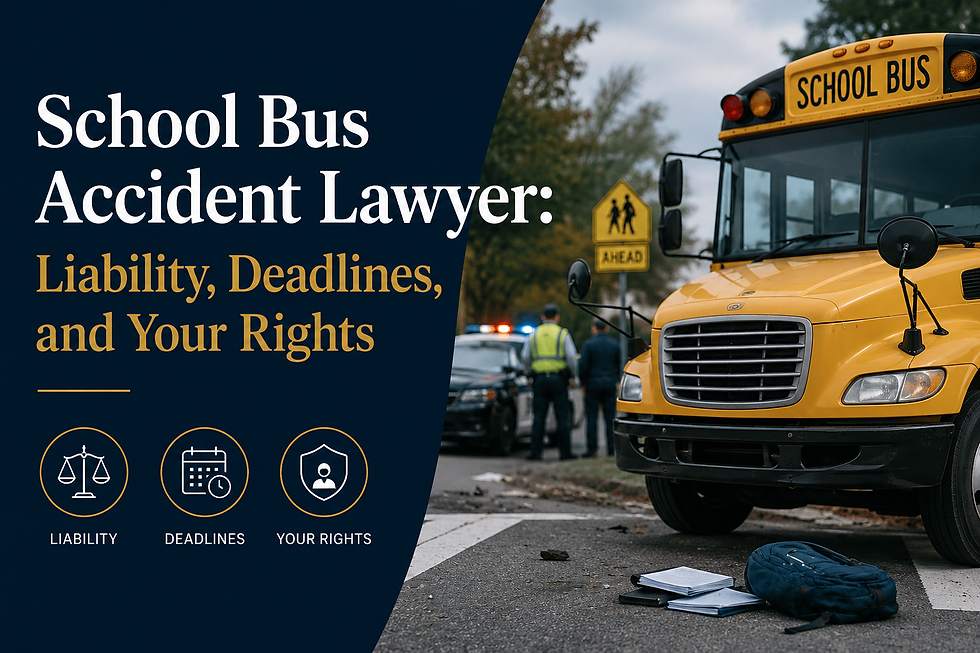
School Bus Accident Lawyer: Liability, Deadlines, and Your Rights
Last Reviewed: May 27, 2026
Publisher: PI Law News
Author: Peter Geisheker
This article is for informational purposes only and does not constitute legal or medical advice. If you have been injured in a truck accident, consult a licensed attorney in your state and seek care from a qualified medical provider.
A school bus accident lawyer determines whether a school district, a private contractor, the driver, a passing motorist, or a vehicle manufacturer is responsible for a crash involving a school bus. Most school-bus deaths happen to occupants of other vehicles and to children in the loading and unloading zone, where about 70% of school-bus pedestrian fatalities are kids — not bus passengers. District claims face short government deadlines.
Key Facts at a Glance
In 2024, 110 people died in school-bus-related crashes nationwide — down 14% from 128 in 2023, per National Safety Council tabulations of NHTSA data.
From 2015–2024, about 71% of school-bus-related deaths were occupants of other vehicles, 15% were pedestrians, 6% were bus passengers, 4% were drivers, and 3% were pedalcyclists.
The Kansas State Department of Education's 53-year loading and unloading survey documents 1,267 fatalities, and 73% of the victims were 9 years old or younger.
School bus drivers reported roughly 43.5 million illegal passes nationwide during the 2022–2023 school year, based on the NASDPTS national stop-arm survey.
From 2013–2022, NHTSA recorded 976 fatal school-transportation-related crashes — an average of about 108 deaths per year.
School buses use “compartmentalization” — strong, closely spaced, energy-absorbing seats — mandated by FMVSS No. 222 instead of universal seat belts; some states now require lap-and-shoulder belts on new buses.
Most U.S. states treat the school district as a common carrier owing the highest degree of care during boarding, transit, and disembarking.
Was your child or family member hurt in a school bus crash? Get a free case evaluation with a school bus accident lawyer — no cost, no obligation, and the government deadline may already be running.
A school bus crash is a uniquely difficult event — emotionally, because children are involved, and legally, because the people most often killed and injured are not the children on the bus but the people outside it. National data consistently show that most school-bus fatalities happen to occupants of other vehicles and to school-age pedestrians in the loading and unloading zone. Understanding why that is, and who is legally responsible when it happens, is the first step toward protecting an injured family.
School bus cases also carry a layered legal structure that ordinary car crashes do not. The bus is operated by a school district (a government entity), a private contractor, or both — and which one decides not only who you sue but how little time you have to do it. The district owes the high common-carrier duty of care to students riding the bus. A passing motorist who runs a stop arm is independently liable. And the bus's onboard cameras, route logs, and stop-arm telemetry are evidence that can disappear within weeks on a routine schedule. This guide explains how those pieces fit together, what the data says, and what you should do.
We rely on primary sources throughout — NHTSA's school-transportation crash data, the Federal Motor Vehicle Safety Standards that govern bus design, the Federal Motor Carrier Safety Regulations, and the controlling case law on the common-carrier duty. For the broader procedural framework on suing a public school district, see our cornerstone on suing a government vehicle.
In this article:
Why are school bus accidents so dangerous to people outside the bus?
What does a school bus accident lawyer do?
Who can be held liable in a school bus crash?
Is the district public or contracted out — and why does it matter?
What is the school bus “danger zone”?
How is fault proven in a school bus case?
What injuries and compensation are typical?
What should you do after a school bus accident?
Frequently asked questions
Why Are School Bus Accidents So Dangerous to People Outside the Bus?
School buses are statistically among the safest vehicles on the road for the children riding inside them, by design. The danger sits outside the bus: in other vehicles, in the cars that illegally pass stopped buses, and in the loading and unloading zone where children cross.
The numbers make the point bluntly. From 2015 to 2024, 71% of school-bus-related deaths were occupants of other vehicles and 15% were pedestrians — only 6% were bus passengers and 4% were drivers. The Kansas State Department of Education's loading/unloading survey, the longest-running dataset on the subject, has documented over 1,200 deaths in 53 years, with about three-quarters of the victims aged nine or younger. Children are in the most dangerous position not when seated on the bus, but when walking around it.
Two design features explain part of the asymmetry. First, school buses use “compartmentalization” under FMVSS No. 222, which protects seated children with high, closely spaced, energy-absorbing seats; the standard prioritizes occupant protection inside the bus over occupant protection outside it. Second, buses are large, tall, and have substantial blind zones, especially at the front fender and along the right side — exactly the zones a child crossing in front of the bus is most likely to occupy.
The compartmentalization standard does an effective job in frontal and rear-end crashes but is less protective in rollovers and side impacts, which is one reason a growing number of states now require lap-and-shoulder belts on new buses. Several states — including California, Texas, Florida, New York, New Jersey, Louisiana, Arkansas, Iowa, Nevada, Mississippi, and Ohio — have adopted or are phasing in lap-and-shoulder requirements, while the federal floor remains compartmentalization. For an injured passenger, the practical consequence is that the available occupant-protection evidence — what restraints existed, whether they were used, and how the bus performed in the crash mode — can vary significantly by state and by bus model year.
What Does a School Bus Accident Lawyer Do?
A school bus accident lawyer investigates the crash, determines who operated the bus, identifies every liable party, files any government notice of claim before the short deadline closes, and pursues compensation through insurance or a lawsuit. The work begins with two threshold questions: was the bus run by the district directly or by a private contractor, and which jurisdictions are involved.
From there, counsel secures the time-sensitive evidence: the bus's onboard camera footage (interior and exterior, including the stop-arm camera if equipped), the driver's qualification file and CDL record under 49 CFR § 383.91, any S-endorsement requirements under 49 CFR § 383.93, training records, maintenance and inspection logs, route and run sheets, the police report, and statements from other students, parents, and motorists. Much of this is in the district's or contractor's control and can be discarded on a routine schedule unless preserved.
In parallel, the lawyer builds the medical and damages picture, identifies all sources of recovery (the district, a contractor, a passing motorist, a vehicle or equipment manufacturer), and — if a public defendant is involved — calendars and files the government notice well within the deadline. As with any commercial truck accident claim, identifying the right defendants early protects the value of the case.
Who Can Be Held Liable in a School Bus Crash?
Liability in a school bus case can reach several parties at once. Each may carry separate insurance, and each may be governed by different procedural rules. The lawyer's job is to identify all of them and pursue every available source of recovery.
The school district. If the district operates its own buses, it is the principal defendant and is treated as a public entity subject to the state tort-claims act. The government-vehicle cornerstone walks through the deadlines and immunities that apply.
A private contractor. Many districts contract bus service to a private company. The contractor is then the operator, the case proceeds under ordinary commercial-insurance rules, and the standard injury statute of limitations applies.
The bus driver. Directly liable for negligent operation. The driver's employer (the district or contractor) is usually responsible for the driver's on-the-job conduct.
A passing motorist. A driver who illegally passes a stopped school bus with its stop arm extended bears independent liability for any resulting injury or death.
A maintenance contractor. Where defective brakes, hydraulics, or other systems caused or worsened the crash, a negligent maintenance provider can be sued.
A vehicle or component manufacturer. Defective seats, restraints, or other equipment can support a product-liability claim against the manufacturer.
Is the District Public or Contracted Out — and Why Does It Matter?
This is often the most important early question in a school bus case. Some districts run their own buses; others contract service to a private bus company. The answer drives both who you sue and how quickly you must act, in exactly the same way the public-versus-private question controls a garbage truck case.
If the district operates the bus directly, the district is the defendant and the claim runs through the state's tort-claims act. That usually means a written notice of claim within a strict deadline, sometimes as short as 90 days, that is much shorter than the ordinary injury statute of limitations. Statutory damage caps and a bar on punitive damages may also apply. The procedural rules and how to meet them are detailed in our suing a government vehicle cornerstone.
If the bus is operated by a private contractor under a district contract, the claim proceeds under ordinary negligence rules against a private company. Commercial insurance is usually substantial, and there is no government notice deadline — only the ordinary statute of limitations — but the contractor will field experienced defense counsel and preserving evidence remains urgent. In some arrangements, both the district and the contractor share responsibility, and the case is built against both.
What Is the School Bus “Danger Zone”?
The danger zone is the area approximately ten feet around the school bus on all sides — the zone where most child-pedestrian school-bus fatalities occur. Children in the danger zone are at risk both from the bus itself (in the driver's blind spots) and from passing vehicles ignoring the stop arm.
NHTSA's school bus safety guidance describes the loading and unloading sequence as the highest-risk part of any bus run. Children approach the bus from the curb, cross in front of it after stepping off, and walk through the same area where the driver's view is most limited. The Kansas State 53-year survey shows the same pattern — most child fatalities involve a student being struck by their own bus or by another vehicle in this zone, with 73% of victims aged nine or younger.
Illegal passing of stopped school buses is the second-half of the danger-zone problem. NASDPTS's national stop-arm survey estimated 43.5 million illegal passes during the 2022–2023 school year. From 2000 to 2022, 55 fatalities occurred in crashes involving a driver illegally passing a stopped school bus, and almost half of those killed were pedestrians 18 or younger. All 50 states require motorists to stop for a school bus with its red lights flashing and stop arm extended; the violation rate persists because enforcement is hard, which is why stop-arm cameras are spreading.
Stop-arm cameras change the evidentiary picture meaningfully. Where the bus is equipped, the camera captures the passing vehicle, its license plate, and the moment of the violation — evidence that almost always settles the liability question between the bus and the passing motorist. About half of U.S. states now allow stop-arm camera enforcement, and many districts are retrofitting their fleets through state grant programs. From a victim's perspective, the practical takeaway is that the footage exists more often than people assume, and asking for it through a preservation letter is one of the first things experienced counsel does after a danger-zone crash.
How Is Fault Proven in a School Bus Case?
Fault is built from the bus's own records and the physical and visual evidence from the scene, not from the driver's account alone. Securing that proof before it disappears is the heart of every school bus case.
Onboard cameras. Modern school buses commonly carry interior cameras (covering the aisle and seats), exterior cameras (covering the doorway and stop arm), and sometimes forward-facing cameras. Footage answers most disputed liability questions if it is preserved in time.
Telematics and ECM data. Speed, braking, door operation, and stop-arm deployment are recorded electronically and tell the second-by-second story of the crash.
Driver records. CDL with passenger and school-bus (“P” and “S”) endorsements, training, background check, hours worked, and any complaint history. Federal rules under § 383.91 and § 383.93 set the baseline.
Maintenance and inspection records. The operator must inspect and maintain the bus to FMCSA standards under 49 CFR Parts 390–397. Missed or falsified inspections support a breach.
Route and stop-arm telemetry. Where the bus was, when it stopped, and whether the stop arm and lights deployed.
Witness accounts. Other students, the driver's monitor or aide (where present), parents at the stop, and passing motorists all add critical context.
Because much of this lives with the district or contractor and can be lawfully discarded on a schedule, a written preservation demand is one of the very first steps experienced counsel sends. Fault analysis at intersection and loading-zone crashes also frequently turns on blind-spot “no-zone” issues, which is its own evidentiary specialty.
By the numbers: Over the decade ending 2022, NHTSA recorded 976 fatal school-transportation-related crashes and roughly 1,082 deaths. About 71% were occupants of other vehicles, not students riding the bus.
What Injuries and Compensation Are Typical?
Injuries in school bus crashes range widely. Children on a bus protected by compartmentalization may walk away from a survivable crash; the same crash for a passenger in another vehicle, or a pedestrian struck in the danger zone, can be catastrophic. The legal calculation has to fit the injury, not the headline.
Traumatic brain injury from head impact or being struck on foot
Spinal cord injury, including partial or complete paralysis
Crush injuries and amputations, especially in danger-zone fatalities
Multiple fractures requiring surgery and rehabilitation
Internal organ damage and internal bleeding
Lacerations and dental/facial injuries from interior impacts on the bus
Wrongful death, given the frequency of fatal pedestrian and child-victim crashes
Damages typically include medical bills, future care, lost income (and lost earning capacity if a child's injury affects future work), pain and suffering, loss of enjoyment of life, and — in fatal cases — wrongful death and survival claims. Catastrophic injuries to a child can lead to a lifetime cost that requires economic and life-care experts to quantify; see our overview of catastrophic injuries and damages in truck and bus cases for the framework.
Two structural points matter for valuation. First, where the school district is the defendant, statutory damage caps and the unavailability of punitive damages may apply — see the government-vehicle cornerstone for the procedural caps that change settlement value. Second, where multiple defendants share fault — say, the district and a passing motorist — each defendant's insurance is a separate source of recovery, and identifying all of them is one of the most important things a lawyer does in these cases.
What Should You Do After a School Bus Accident?
The first days after a school bus crash shape the rest of the case. The medical record is strongest when created promptly, the evidence trail is freshest immediately after, and — if a school district is involved — the deadline clock is already running.
Get immediate medical care. For your child and yourself, even if injuries seem minor. Head and internal injuries can present hours or days later.
Identify the operator. Photograph the bus, its number, the district or contractor name, and the license plate. Note whether the bus is district-owned or marked with a contractor name.
Document the scene. Photographs of vehicles, skid marks, signage, weather, the stop, and any visible injuries. Get names and contact information for any witnesses.
Preserve evidence. Have a lawyer send a preservation letter for the bus's onboard camera footage, telematics, and maintenance records before they are overwritten or discarded.
Do not give a recorded statement. To the district's risk department, the contractor's insurer, or a passing motorist's insurer, until you have spoken with counsel.
Speak with a lawyer immediately. If a public district is involved, the notice-of-claim deadline can be a fraction of the ordinary statute of limitations, and missing it usually bars the case.
Ready to talk to someone? A free case evaluation carries no cost and no obligation — and protects your right to act in time.
School Bus Safety: Federal Standards and Key Statistics
Topic | Standard or Statistic | Source |
School bus crash deaths (2024) | 110 nationwide, down 14% from 128 in 2023 | |
Share of deaths in other vehicles (2015–2024) | ~71% — only 6% were bus passengers | |
KSDE 53-year loading/unloading survey | 1,267 fatalities; 73% age 9 or younger | |
Annual illegal stop-arm passes (2022–23) | ~43.5 million estimated nationwide | |
Occupant protection design | Compartmentalization — high, padded, closely spaced seats | |
Driver licensing | CDL + Passenger (P) and School Bus (S) endorsements | |
Carrier safety rules | FMCSR for passenger carriers (49 CFR Parts 390–397) |
Frequently Asked Questions
My child was hurt on a school bus. Do I sue the district or the bus company?
It depends on who operates the bus. If the district runs its own buses, you typically sue the district under the state tort-claims act, with a short notice deadline. If service is contracted to a private bus company, you sue the contractor under ordinary negligence rules with the standard statute of limitations. In some arrangements, both can be liable. See our government-vehicle cornerstone for the procedural rules that apply when a district is the defendant.
What if my child was hit by a car that illegally passed a stopped school bus?
The passing motorist bears independent liability for any injury or death. Stop-arm violations are a leading cause of school-bus pedestrian fatalities, with an estimated 43.5 million illegal passes a year. The driver's insurance is the first source of recovery; the district or contractor may share liability if a procedural failure contributed.
How long do I have to file a school bus injury claim?
If a public district is involved, you may have only months — sometimes 90 days — to file a written government notice of claim, long before the ordinary statute of limitations expires. Against a private contractor, the ordinary state statute applies, but evidence still vanishes quickly. Either way, contact a lawyer as soon as possible.
Does the school district owe a higher duty of care to my child?
Generally yes. Most states treat school transportation as a common carrier obligation, which imposes the highest degree of care during boarding, transit, and disembarking. The duty often does not extend to the moments after a child has safely crossed the street and reached the curb, but it normally covers the loading and unloading zone.
Why don't school buses have seat belts?
Most large school buses use “compartmentalization” under FMVSS No. 222 — high, closely spaced, energy-absorbing seats designed to contain children during a crash. NHTSA has long considered this protection effective for the typical crash profile, though several states now require lap-and-shoulder belts on new buses, and the policy continues to evolve.
What evidence is most important in a school bus case?
The bus's onboard camera footage (interior, exterior, and stop-arm cameras), telematics data, the driver's qualification and training file, maintenance and inspection records, route and stop logs, and witness statements. Much of this is in the operator's control and can be lost within weeks, so a preservation letter should go out fast.
What kind of compensation can my family recover?
Economic damages (medical bills, future care, lost income, lost earning capacity), non-economic damages (pain, suffering, loss of enjoyment), and, in fatal cases, wrongful-death and survival damages. Where a public district is the defendant, statutory caps and the unavailability of punitive damages may apply.
Are school bus drivers held to special licensing requirements?
Yes. School bus drivers must hold a commercial driver's license with both a Passenger (P) endorsement and a School Bus (S) endorsement under 49 CFR § 383.93, and must comply with federal hours-of-service rules where applicable. Failure to maintain qualifications supports a negligence claim.
Can the school district be liable if my child was hurt at the bus stop, not on the bus?
Sometimes. A district can have responsibilities for stop selection, supervision, and warning students of known hazards, depending on state law and district policy. The common-carrier duty itself generally attaches when boarding begins and ends when disembarking is complete, but other duties can apply outside that window.
How quickly should I contact a school bus accident lawyer?
Immediately. If the district is the operator, the government notice deadline can be measured in months and missing it forfeits the claim no matter how strong the underlying case is. Evidence in school bus cases is also unusually perishable. A free consultation carries no cost or obligation.
The Bottom Line on School Bus Accident Claims
School bus crashes are different from ordinary motor-vehicle crashes in three ways that all matter to your case. The victims are disproportionately people outside the bus — occupants of other vehicles and school-age pedestrians in the danger zone — so identifying the right defendant often means looking past the bus itself. The operator is frequently a public school district, which triggers a short government notice deadline that can expire before parents realize a claim is even possible. And the proof is held in the bus's electronic systems, which can be overwritten on routine schedules.
A useful way to think about it is that you are running three clocks at once. The medical clock measures how quickly your child's injuries are documented and treated; care delays both worsen outcomes and weaken the claim. The evidence clock measures how long the bus's onboard camera footage, telematics, and maintenance records survive on the operator's routine schedule — often days to weeks. And the legal clock is the shortest of the three when a public district is involved, sometimes as little as 90 days for a written notice of claim. The right lawyer does not solve all of this for you, but starts every clock on a sound footing while you focus on your child.
If your child or family member was hurt in a school bus crash, do not wait. Contact us for a free consultation to be connected with a school bus accident lawyer who can preserve the evidence, identify every responsible party, and protect your right to recover.
Authoritative Sources and References
School Bus Crashes — Injury Facts. National Safety Council. 2024 data.
School Bus Safety. National Highway Traffic Safety Administration.
School-Transportation-Related Crashes: 2012–2021 Data. NHTSA FARS.
49 CFR § 571.222 — Standard No. 222, School bus passenger seating and crash protection. eCFR.
49 CFR § 383.91 — Commercial motor vehicle groups (passenger endorsement). eCFR / FMCSA.
49 CFR § 383.93 — Endorsements (school bus and passenger). eCFR / FMCSA.
Summary of Hours of Service Regulations. Federal Motor Carrier Safety Administration.
Passenger Carrier Safety. Federal Motor Carrier Safety Administration.
49 CFR Subtitle B, Chapter III — Federal Motor Carrier Safety Regulations. eCFR.
Editorial Standards and Review
This article was reviewed for accuracy, clarity, and alignment with current safety and legal data as of May 2026.
Crash and fatality statistics are sourced from the National Safety Council, NHTSA, and state education departments.
Federal vehicle standards are cited to the eCFR and the FMVSS series.
Driver-licensing requirements are cited to 49 CFR §§ 383.91 and 383.93.
This content is educational only and does not constitute legal advice.
Every fact and statistic has been verified against its cited source (Zero-Hallucination Policy).
Last Reviewed: May 27, 2026. Next Scheduled Review: November 2026.
For specific legal guidance on your situation, consult a licensed attorney in your jurisdiction.