Jackknife Truck Accident Settlements: What Drives Your Payout

Last Reviewed: June 9, 2026
Publisher: PI Law News
Author: Peter Geisheker
This article is for informational purposes only and does not constitute legal or medical advice. Settlement values vary enormously by case, and nothing here is a prediction of any outcome. If you were hurt in a jackknife truck accident, consult a licensed attorney in your state.
There is no single average payout for a jackknife truck accident, because settlement value tracks injury severity, not the type of crash. In practice, jackknife cases run higher than ordinary collisions: the trailer sweeps across multiple lanes, injuries are frequently catastrophic, and the carrier's insurance starts at a federal minimum of $750,000 and often stacks far higher.
Key Facts at a Glance
"What is the average payout for a jackknife truck accident?" is one of the first questions injured people ask, and the honest answer is that no reliable single average exists. A payout is not set by the crash being a jackknife; it is set by how badly someone was hurt, who is legally responsible, and how much insurance is available to pay the claim.
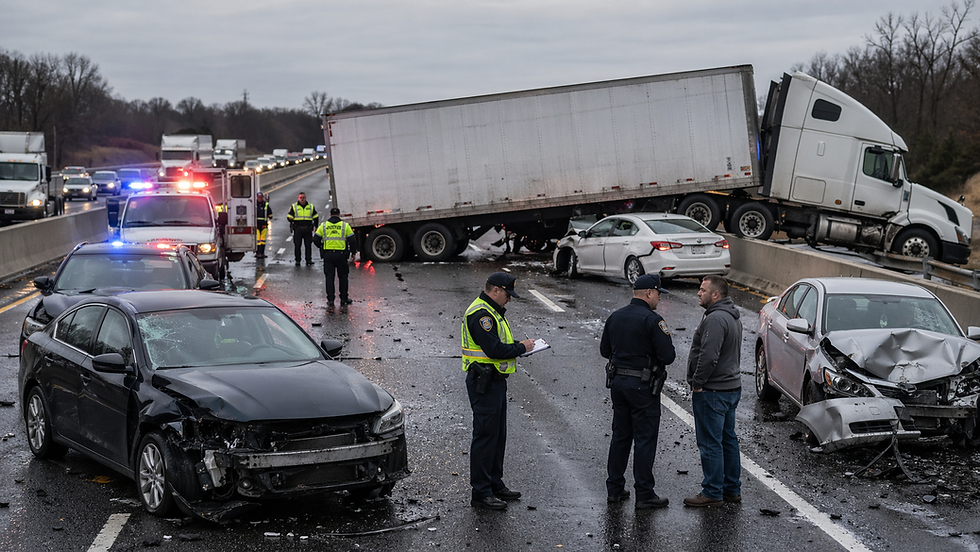
What can be said is that jackknife crashes skew toward the severe end. When a tractor-trailer loses control and the trailer folds toward the cab, it sweeps across lanes and can strike several vehicles at once (Source: Wagner Reese). Large trucks are heavy and unforgiving: in 2021, FMCSA recorded 5,904 large trucks and buses in fatal crashes, an 18 percent increase over 2020 (Source: FMCSA).
So rather than chase a meaningless "average," the useful question is what drives the number. This guide walks through the factors that actually determine a jackknife settlement: the severity of the injuries, the number of liable parties, the size of the trucking company's insurance tower, and how fault is divided when several vehicles are involved.
Understanding those drivers is also how you protect the value of your own claim, because the difference between a fair recovery and a lowball offer often comes down to evidence and timing, not the label on the crash.
In this article
What is the average payout for a jackknife truck accident?
What determines the value of a jackknife settlement?
Why are jackknife crashes often catastrophic?
How does insurance limit or expand a jackknife payout?
How does fault affect what you can recover?
How do you protect the value of a jackknife claim?
What is the average payout for a jackknife truck accident?
There is no dependable average, and any firm that advertises a specific "average jackknife settlement" figure is selling a number that does not mean much. Two jackknife crashes can produce wildly different payouts depending on the injuries and the insurance behind them.
The reason is simple: a settlement compensates for harm, not for the mechanics of the wreck. A jackknife that causes a few days of soft-tissue pain and a jackknife that causes a spinal cord injury and a fatality are the same "type" of crash, yet their values are not remotely comparable. Settlement amounts are built from the specific losses in a specific case (Source: how multi-million-dollar truck settlements are calculated).
What is fair to say is directional: because jackknife crashes tend to involve high speed, loss of control, and multiple impacts, they cluster toward the more serious, higher-value end of the truck-accident range. But "higher than a fender-bender" is not a dollar figure, and an honest valuation only comes after the injuries, the liability picture, and the available insurance are known.
Advertised "average" figures mislead in a specific way: they blend together cases that have nothing in common. A page claiming the "average jackknife settlement is $X" is usually averaging a handful of unrelated results, or simply repeating a number with no underlying data behind it. It tells you nothing about what a case with your injuries and your facts is actually worth.
A grounded valuation works the opposite way. It starts from your specific losses, medical costs, future care, lost income, pain and suffering, and then asks whether the responsible parties carry enough insurance to pay them. The sections that follow break those drivers down in order.
What is a realistic range for a jackknife truck accident payout?
Because no dependable average exists, the most honest way to think about value is in tiers tied to injury severity, with the firm caveat that any tier can shift dramatically based on liability and the insurance available.
At the lower end sit cases with full physical recovery, short treatment, and clear but modest losses. In the middle are injuries requiring surgery or extended rehabilitation that leave lasting but not permanent effects. At the high end are catastrophic outcomes, traumatic brain injury, spinal cord injury, amputation, or death, where lifetime medical care and lost earning capacity drive value the highest (Source: catastrophic injury costs).
Jackknife crashes are overrepresented in that top tier for the reasons described below, but tier alone does not produce a number. Two catastrophic-injury cases can diverge sharply if one defendant carries only a $750,000 minimum policy while the other is a large fleet with a layered tower of excess coverage. That is why the insurance investigation matters as much as the medical one (Source: how settlements are calculated).
This is also why a careful attorney resists quoting a figure early. An estimate offered before the full medical picture and the complete insurance picture are known is a guess, and a guess that anchors a victim's expectations too low can cost real money at settlement.
It cuts the other way too. An inflated expectation, fed by a stranger's advertised "average," can push a victim to reject a fair offer or to distrust sound advice. The goal of valuing a case from the facts up is not pessimism or optimism; it is accuracy, because only an accurate number lets you recognize a fair settlement when one is on the table and hold firm when one is not.
What determines the value of a jackknife settlement?
A jackknife settlement is assembled from categories of damages, then shaped by liability and by how much insurance can actually be reached. The biggest single driver is almost always the severity and permanence of the injuries.
Damages generally fall into three buckets. Economic damages cover measurable losses such as medical bills, future medical care, lost wages, and lost earning capacity. Non-economic damages cover pain, suffering, disfigurement, and loss of enjoyment of life. In cases involving especially reckless conduct, exemplary or punitive damages may also be available to punish the wrongdoer.
Those categories are then filtered through two practical limits: who is liable, and how much coverage exists. The table below summarizes the main drivers and which way each one pushes the number.
Value driver | Effect on the payout | Source |
Injury severity | The largest driver. Catastrophic injuries such as TBI, spinal cord damage, or death push value the highest. | |
Number of defendants | Driver, carrier, maintenance provider, and cargo loader can each carry separate insurance, expanding the money available. | |
Available insurance | Federal floor is $750,000 for general freight; many carriers stack excess layers far above it. | |
Clarity of liability | Strong, well-documented fault evidence increases settlement leverage and the realistic value. | |
Comparative fault | The injured party's own share of fault can reduce the award proportionally, or in some states bar it. | |
Egregious conduct | Hours-of-service or logbook violations and reckless operation can support punitive or exemplary damages. |
Notice that only one of these, the injuries, is fixed by the crash itself. The rest depend on investigation and proof, which is why two superficially similar jackknife cases can settle for very different amounts.
This is also why preserving evidence is a value question, not just a liability question. The same black-box data and logbook records that prove the carrier was negligent are what move a case from a contested, discounted claim to one an insurer will pay near its true worth (Source: black box EDR data and settlement value).
Why are jackknife crashes often catastrophic?
Jackknife crashes earn their reputation for severity from basic physics: a loaded tractor-trailer can weigh 20 to 30 times as much as a passenger car, and when the trailer breaks traction and swings toward the cab, that mass sweeps sideways across the road.
The result is rarely a single clean impact. As the trailer folds into a V or L shape, it can block several lanes at once, and other drivers traveling at highway speed have little room to avoid it (Source: Lorenz & Lorenz). That is how a jackknife so often becomes a multi-vehicle pileup with several injured victims rather than one.
The most common triggers are well documented: braking too hard or improperly so the drive wheels lock, excessive speed for conditions, slick roads from rain, snow, or ice, brake or tire defects, and imbalanced or overloaded cargo that shifts the truck's center of gravity (Source: Munley Law). Many of these point back to the driver or the carrier's maintenance and loading practices, which is central to both liability and value.
FMCSA data reported by trucking-injury firms shows roughly 169 fatal and about 1,000 injury-causing jackknife crashes in a single recent year, a reminder that these are disproportionately serious events, not minor mishaps (Source: Fieger Law citing FMCSA).
Because the injuries skew toward the catastrophic, jackknife cases frequently involve the kinds of long-term costs, lifetime medical care, permanent disability, and lost earning capacity, that drive settlement value upward (Source: catastrophic truck injury costs).
The multi-vehicle nature compounds the severity. A single jackknife can injure the occupants of several vehicles at once, each with separate injuries and separate claims, which is part of why these crashes generate both higher aggregate damages and far more complex litigation than a typical two-car collision. It also means the evidence about sequence and fault, who struck whom and when, becomes critical to sorting out each victim's recovery.
Does a jackknife accident pay more than other truck crashes?
On average, jackknife cases tend to resolve for more than minor truck collisions, but that is a function of severity, not a premium attached to the word "jackknife." Insurers and juries pay for harm; the crash type matters only because of the harm it tends to produce.
Several features push jackknife cases up the scale. The trailer sweeping across multiple lanes produces multiple impacts and often multiple victims. Loss of control at highway speed produces high-energy collisions. And the usual causes, improper braking, speeding, defective equipment, and illegal scheduling, frequently point to clear carrier negligence, which strengthens liability and therefore value (Source: who is liable in a multi-vehicle jackknife).
But a jackknife with minor injuries can still be a modest claim, and a straightforward rear-end crash by a fatigued trucker that causes a spinal injury can be worth far more. The lesson is consistent: do not value a case by its crash type; value it by the injuries, the liability, and the coverage available to pay (Source: how settlements are calculated).
How does insurance limit or expand a jackknife payout?
A settlement can only be paid from money that exists, so the trucking company's insurance is often the practical ceiling on a jackknife payout, and sometimes the floor.
Federal law sets minimum liability coverage under 49 CFR 387.9: $750,000 for most general freight, $1 million for certain oil cargo, and $5 million for hazardous materials (Source: eCFR; FMCSA). Those are floors, not norms; brokers and shippers frequently require $1 million, and large fleets often carry layered "towers" of excess coverage well into the tens of millions.
The $750,000 federal minimum was set by the Motor Carrier Act of 1980 and has never been adjusted for inflation. In today's dollars it would exceed $2.8 million, which is why a single catastrophic jackknife claim can outstrip a small carrier's minimum policy (Source: Aguiar Injury Lawyers).
This is where multiple defendants matter. If the driver, the motor carrier, a maintenance contractor, and a cargo loader are each potentially liable, each may bring a separate policy to the table, expanding the total recovery beyond any one carrier's limit (Source: commercial insurance limits guide). Conversely, an underinsured small carrier can leave a badly hurt victim chasing coverage that does not exist, which makes identifying every insured party early one of the most valuable steps in the case.
Excess and umbrella layers are common with larger carriers, and a serious jackknife claim often reaches past the primary policy into those layers. Mapping the full structure, primary coverage, every excess layer, and any separately insured defendant, is one of the highest-value early tasks in a catastrophic case, because coverage that is never identified is money that is never recovered.
How do multiple victims in a jackknife pileup affect each payout?
Jackknife crashes frequently injure several people at once, and when multiple victims share a single at-fault carrier, they can end up competing for the same pool of insurance money.
A liability policy has limits. If a small carrier holds only the $750,000 federal minimum and a jackknife seriously injures four people, that single policy may be nowhere near enough to compensate everyone fully. In that situation, victims can find themselves effectively competing for a limited fund, and the timing and strength of each claim can influence what each person ultimately recovers (Source: commercial insurance limits guide).
That dynamic makes two things especially valuable. First, identifying every liable defendant, because additional defendants bring additional policies that enlarge the total money available to all victims rather than forcing them to split one inadequate limit. Second, acting early, because a well-documented, clearly supported claim is in a far stronger position than one still being assembled when a limited fund is being allocated.
It also explains why catastrophic multi-victim jackknife cases are among the most contested in trucking litigation: the stakes are high, the available coverage is often inadequate, and every party, including co-victims, has an interest in how fault and money are divided (Source: who is liable in a multi-vehicle jackknife).
How does fault affect what you can recover?
Jackknife crashes are frequently multi-vehicle, and that makes the allocation of fault one of the most consequential questions in the case, both for who pays and for how much you keep.
Liability in a jackknife is often shared. The driver may have braked improperly or sped for conditions; the carrier may have pushed an illegal schedule or skipped maintenance; a cargo loader may have unbalanced the trailer; a parts maker may have supplied defective brakes. Sorting out each party's share is the subject of its own analysis (Source: who is liable in a multi-vehicle jackknife). The more clearly fault lands on well-insured defendants, the stronger the claim.
Your own conduct matters too. Under comparative negligence rules, a payout is reduced by your percentage of fault; in a few states, being too far at fault can bar recovery entirely. In a chaotic multi-car jackknife pileup, defendants routinely try to shift blame onto injured plaintiffs to shrink what they owe, which is why preserving evidence of how the crash actually unfolded directly protects the value of the claim.
Practically, the investigation that establishes someone else's fault is the same investigation that defends your own share of it. Crash reconstruction, the truck's recorded data, and consistent witness accounts do double duty: they raise the value by pinning liability on the carrier, and they protect the value by rebutting attempts to blame you for a crash a tractor-trailer set in motion.
How do you protect the value of a jackknife claim?
The value of a jackknife claim is won or lost in the first weeks, long before any settlement talk, because the evidence that proves both fault and damages disappears quickly.
The truck's electronic control module, or black box, can record speed, braking, and throttle in the seconds before the crash, and that data is often decisive in a jackknife where the question is whether the driver braked improperly or sped for conditions (Source: black box EDR data and settlement value). It is also routinely overwritten as the truck keeps running, so a prompt evidence-preservation letter matters.
Get prompt medical care and keep documenting. The medical record is the backbone of the damages number; gaps in treatment are used to argue the injuries were minor.
Preserve the truck data early. A truck accident attorney can send a spoliation letter directing the carrier to retain the ECM data, driver logs, and dashcam footage.
Identify every defendant. Each additional liable party can mean another insurance policy, which is often what lifts a recovery above a small carrier's minimum limit.
Do not accept an early offer. Insurers move fast after catastrophic jackknife crashes precisely because the full extent of the injuries is not yet known.
Timing compounds all of it. Police reports are finalized, the wrecked vehicles are released and repaired or scrapped, surveillance footage from nearby businesses is overwritten, and witnesses scatter. Each of those is a piece of proof that, once gone, cannot be recreated, and its absence is something a defense team will use to argue the crash and the injuries were less serious than they were.
None of this changes the crash, but all of it changes the number, because a well-documented claim with clear liability and identified coverage settles for far more than the same injuries presented without proof.
Frequently Asked Questions
What is the average settlement for a jackknife truck accident?
There is no reliable average, and a specific advertised figure should be treated with skepticism. A jackknife settlement reflects the actual harm in your case, which means injury severity, liability, and available insurance drive the number far more than the fact that the crash was a jackknife. A minor-injury case and a catastrophic-injury case are the same crash type with completely different values.
How much is a jackknife truck accident case worth?
It depends on three things: how severe and permanent the injuries are, how clearly fault lands on well-insured defendants, and how much insurance is available to pay. Because jackknife crashes tend toward serious, multi-vehicle outcomes, they often sit at the higher end of the truck-accident range, but only a case-specific review of the injuries and the insurance can produce an honest estimate.
Who pays for a jackknife truck accident?
Usually the trucking company's liability insurer, but often not only them. Depending on the cause, the driver, the motor carrier, a maintenance contractor, a cargo loader, or a parts manufacturer can each be liable and each may carry separate coverage. The federal minimum for a freight truck is $750,000, but many carriers stack excess layers well above that.
Are jackknife accidents always the truck driver's fault?
No. Improper braking and speeding by the driver are common causes, but a jackknife can also stem from defective brakes or tires, poorly maintained equipment, imbalanced cargo loaded by someone else, or hazardous road conditions. Liability is frequently shared among several parties, and identifying each one is what expands the insurance available to pay your claim.
How long does a jackknife truck accident settlement take?
It varies widely with the severity of the injuries and the disputes over fault. Cases generally should not settle until your medical condition has stabilized enough to value future care, and multi-vehicle jackknife cases with contested liability take longer. You can read more about the stages in our truck accident lawsuit timeline, and you can contact us for a free consultation to discuss your specific situation.
What injuries are most common in jackknife truck accidents?
Because of the mass and the multi-vehicle nature of these crashes, jackknife injuries skew severe: traumatic brain injuries, spinal cord injuries, multiple fractures, internal injuries, and fatalities. These catastrophic injuries carry long-term medical and lost-income costs, which is a major reason jackknife cases tend to be valued higher than ordinary collisions.
Does insurance always cover a jackknife accident?
Liability insurance generally covers it, but the amount can fall short. The $750,000 federal minimum was set in 1980 and never adjusted for inflation, so a single catastrophic claim can exhaust a small carrier's policy. Reaching additional defendants and their separate policies is often the only way to fully cover a severe jackknife loss.
Can I recover if I was partly at fault in a jackknife pileup?
In most states, yes, but your recovery is reduced by your percentage of fault under comparative negligence rules, and a few states bar recovery if you are too far at fault. Multi-vehicle jackknife pileups invite blame-shifting, so evidence showing how the crash actually unfolded directly protects what you can recover.
How are jackknife truck accident settlements calculated?
Settlements are built from economic damages such as medical bills, future care, and lost earning capacity, plus non-economic damages such as pain and suffering, and sometimes punitive damages for egregious conduct. That total is then shaped by liability and by the insurance available. The crash type does not set the figure; the specific losses and the available coverage do.
Conclusion
There is no average payout for a jackknife truck accident worth relying on, because the number is built from your injuries, your liability picture, and the insurance that can actually be reached, not from the label on the crash. What is consistent is that jackknife crashes tend toward the catastrophic, which pushes their value toward the higher end of the range.
There is also no downside to asking early. If your case turns out to be modest, you have lost nothing by understanding it. If it is catastrophic, and jackknife cases often are, the early steps of preserving evidence and identifying every insurer are exactly what determine whether the full value is ever recovered.
Because the evidence that proves both fault and damages disappears within weeks, the single most important thing you can do to protect the value of a jackknife claim is act early to preserve the truck's data and document the injuries. If you want a clear-eyed read on what your case may be worth, discuss your case at no cost with a personal injury professional.
References
49 CFR § 387.9, Financial responsibility, minimum levels. Cornell Legal Information Institute.
Minimum Levels of Financial Responsibility (§ 387.9 schedule). FMCSA, CSA Safety Planner.
Large Truck and Bus Crash Facts 2021. Federal Motor Carrier Safety Administration.
What Are the Causes of Jackknife Truck Accidents? Munley Law.
What Causes a Truck to Jackknife? (FMCSA jackknife crash data). Fieger Law.
Common Jackknife Truck Accident Causes and Injuries. Lorenz & Lorenz.
Trucking Insurance Requirements: the $750,000 minimum and the inflation gap. Aguiar Injury Lawyers.
Commercial Truck Insurance Requirements (FMCSA + State Minimums), 2026. Logrock.
Editorial Standards and Review
This article was written and published by PI Law News and last reviewed on June 9, 2026. Every regulation, insurance figure, and crash statistic in it was verified against a primary or authoritative source at the time of writing, including the Code of Federal Regulations and the Federal Motor Carrier Safety Administration, each linked inline and listed in the References section above.
PI Law News follows a strict Zero-Hallucination Policy: we publish no figure or claim we cannot trace to a verifiable source, and we deliberately decline to invent an "average" jackknife settlement because no reliable national figure exists. This content is general legal information, not legal advice or a prediction of any outcome; settlement values depend on the facts of each case. Consult a licensed attorney in your state for advice about your situation.